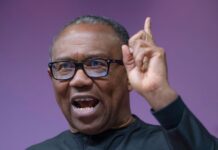


Liberian vice president, Mr Joseph Boakai yesterday, August 23 praised the efforts of Nigerian businesses in stabilising the economy of his nation.
According to Boakai, Nigeria had and continue to play a major role in ensuring peace in Africa.

Leadership reports that Boakai stated that most of the banks as well as insurance firms in Liberia are owned by Nigerians.
Boakai made the revelation in Sokoto when he paid a courtesy call on the Sultan of Sokoto, Alhaji Sa’ad Abubakar III.
He admitted that Nigeria was the first African country to come to their aid for peace restoration during the Liberian civil war.
He also added that Nigeria showed their unreserved love for Liberia once against during the dreaded Ebola days which ravaged his country last year.
His words: “Since independence and when we came into hostilities, Nigeria was the first African country to come to our rescue.
“The Sultan was part of this history and Nigeria had made ultimate sacrifice in restoring peace to our nation.
Read Also:
“During the Liberian civil war, the brave military men and women of Nigeria were the first to set their foot on the Liberian soil.”
While divulging that most banks and insurance firms in Liberia were owned by Nigerians, Boakai added that many Nigerians are in Liberia as lecturers and medical doctors too.
Responding, the Sultan of Sokoto said until there is unhindered peace, no nation can develop.
According to him, this was why Nigeria committed human and material resources towards restoring peace in Liberia during their dark days.
The Sultan called on all African countries and leaders to ensure mutual understanding, urging them to not only see themselves as one big family but also work towards sustaining the family ties at all-time.
Meanwhile, four major blue-chip Nigerian companies recently lost as much as N51.86 billion in the first half of 2016 as the economy continues to take a dip.
Similarly, South Africa has overtaken Nigeria as Africa’s biggest economy in dollar terms.
The change in status of both countries was attributed to the appreciation of the rand, South Africa’s currency, and the devaluation of the Nigerian naira.
Credit: