
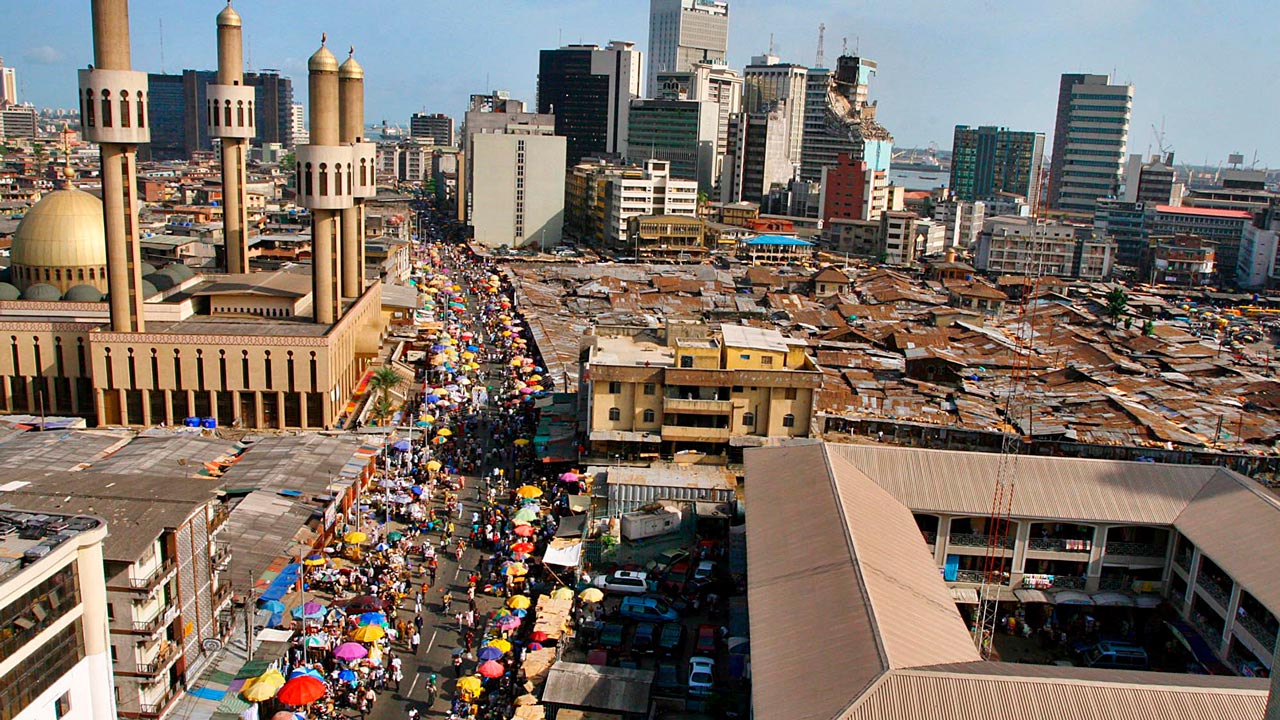


Aerial view of buildings and markets on Lagos Island.

The pre-elections’ development, policy implementation slowdown and sell-offs by foreign investors in 2018, will slow growth in the stock market in this first-half (H1) 2019.
Besides, the monetary tightening by members of the frontier markets, will play a part in the projected developments, the Chief Economist and Advisory Partner at Pricewaterhouse Coopers (PWC), Andrew Nevin, has said.
“Overall, key drivers for the market from H1 2019 include commodity prices; exchange rate movement and stability; and inflation rate”, Nevin said in Lagos, at the breakfast meeting of Association of Corporate Treasurers of Nigeria (ACTN).
The forum was for the Corporate Treasurers to have an in-depth discourse on the possible impacts of the business environment within the year and ways of restoring confidence in the financial markets.
The Chairman of Interim Council, ACTN, Zeal Akaraiwe, noted that the association fosters the interests of corporate treasurers in Nigeria, by providing a platform for policy advocacy, discussions on issues of mutual interest, education and standard development of the corporate treasury function.
Akaraiwe, who is also Managing Director/Chief Executive Officer of Graeme Blaque Advisory, said that as part of the efforts of the association towards the education and enlightenment of its members, it regularly host breakfast meetings where issues on economic policies as well as policy directions and their impacts on the activities of the corporates are reviewed and discussed with regulators, economists and financial markets experts as lead speakers/discussants.
But at the meeting, themed: “2019 Economic and Business Outlook”, supported by FMDQ OTC Securities Exchange, Nevin noted that in 2018, his organisation predicted a moderate increase in foreign portfolio investment and a slowdown by first-half of 2018, driven by uncertainty ahead of the elections.
Read Also:
“We expect portfolio investment growth in first-half of 2019 to remain low and lower than pre-2018 level, dampened by lackluster implementation of policy reforms,” he said.
According to him, key risks to foreign investment in Nigeria are declining interest rate differentials, as advanced economies continue to tighten policy rates; political instability, following the 2019 elections; unfavourable investment climate; and broad macroeconomic instability.
Global FDI flows fell by 19 per cent in 2018. However, 2018 FDI flows to Africa increased by six per cent from $38 billion to $40 billion. South Africa recorded growth; Egypt grew by seven per cent. Nigeria, on the other hand, fell by 36 per cent (to $2.2 billion) and was overtaken by Ghana with $3.3 billion.
Nevin noted that Nigeria is not among the fastest growing economies in Sub-Saharan Africa (SSA) by percentage growth in GDP, as “the largest economies in Sub-Saharan Africa offer opportunities for business growth, particularly when considering an expansion into new regions.
According to PwC’s estimate, Diaspora remittances to the country in 2018 were worth $25 billion, representing 6.1 per cent of the nation’s GDP.
“This figure translates to 83 per cent of the Federal Government budget in 2018 and 11 times the Foreign Direct Investment (FDI) flows in the same period. Nigeria’s migrant remittance inflows was also seven times larger than the net official development assistance (foreign aid) received in 2017 of $3.359 billion”, he noted.
Nigeria, according to the PwC chief economist is not among the fastest growing economies in Sub-Saharan Africa (SSA) by percentage growth in GDP.
“The largest economies in Sub-Saharan Africa offer opportunities for business growth, particularly when considering an expansion into new regions,” he said.
He believes that rising oil prices will not be sustained in the long term as oil production increases globally and demand stagnates.
“Fluctuating prices leave Nigeria’s oil-driven economy vulnerable to external shocks. The oil production curve continues to slope downward and below the 2 million barrels per day (mbpd) average target set by the central government.
“OPEC has lowered Nigeria’s oil production level to 1.685mbpd. We expect this cut coupled with fluctuations in oil price and potential supply disruptions to impact the 2019 budget implementation”, he added.