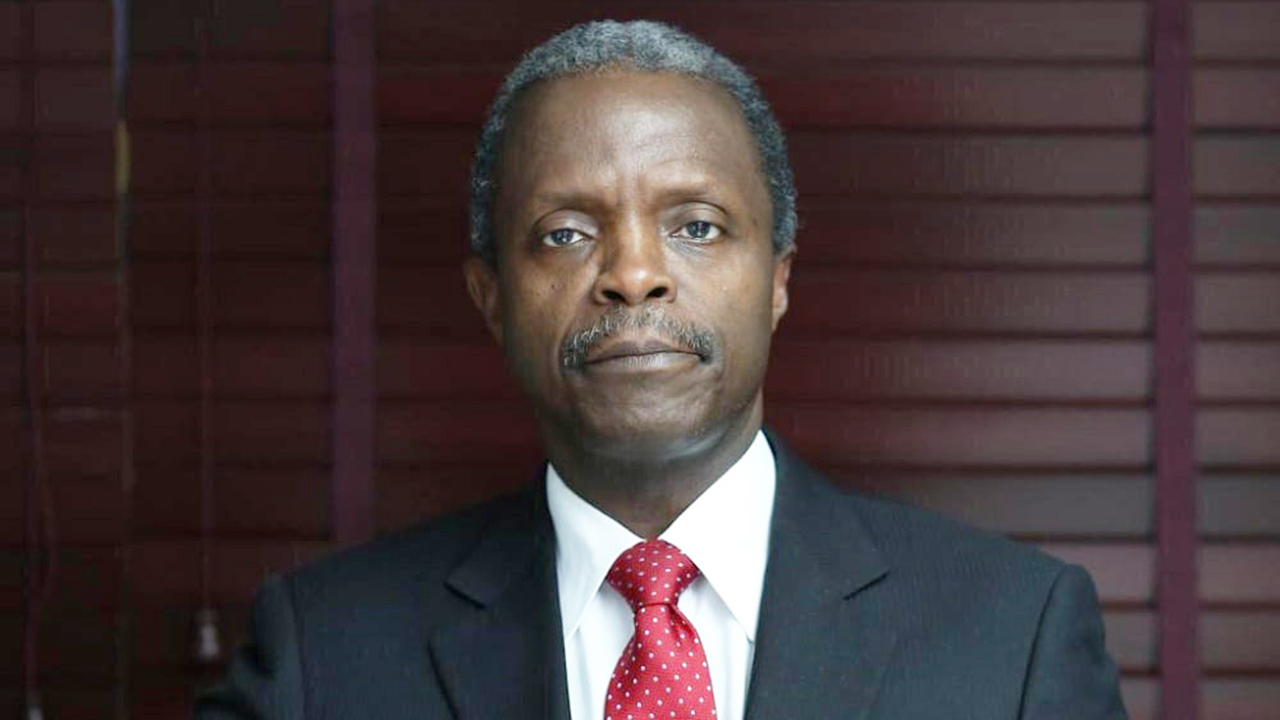


[FILE PHOTO] Vice Prseident Yemi Osinbajo

Vice President Yemi Osinbajo, at recent meeting of the Nigeria Industrial Policy and Competitiveness Advisory Council, announced that, “President Muhammadu Buhari has approved new anti-smuggling reforms.”
The approval followed an observation by a member on the urgent issue of smuggling and effects on the nation’s economy, which then became one of the thematic areas of focus for the Council.
At the last meeting, the Council said in a statement, there were updates on broadband penetration, increased electricity supply through the use of unutilised power, as well as skills development and employment in the sugar industry.
These are in furtherance of the main purpose of the Council, which one of its Vice Chairmen, Dr. Okechukwu Enelamah, Minister of Industry, Trade and Investment, said is to implement critical interventions at the highest level to accelerate industrialisation.
He explained that, “The Council’s mandate is to assist the government in formulating policies and strategies that will enhance the performance of the industrial sector through partnerships with the private sector.”
At the inauguration of the Council last year, Osinbajo had said: “It is not just a patriotic duty, but one that will give our country a real chance to be globally competitive in business and commerce. The Council is important because we acknowledged that partnering with the private sector is a key enabler for achieving our industrialisation targets.”
The Industrial Council is focused on six thematic areas; each area is driven by a sub-committee with members from the public and private sectors. The areas are Critical Infrastructure; Skills & Capacity Building, Policy & Regulation, Trade & Market Access, Financing and Engagement with State Governments.
Some of the Council’s initiatives include the following:
Fight against smuggling, aimed at implementing initiatives to minimise smuggling by 50 per cent in the short to medium term.
Read Also:
The proposed anti-smuggling initiatives and recommendations have been approved by the Federal Executive Council and President Muhammadu Buhari.
Trade and Markets – to improve access to Nigeria’s priority markets; drive 30-40 per cent increase in ICT exports; increase foreign earnings by $1 billion – $4 billion annually from agro-allied businesses and create 475,000 jobs.
Parts of the initiatives also include the establishment of an ICT cluster; addressing sectoral issues in the cotton, textiles and garment sector, as well as those in the agro-allied sector; and heavy metals; and review and renegotiate Nigeria’s trade agreements with priority markets.
Skills and Capacity Building involves plans to bridge the gap between the skills demanded by industry and supply by Nigerian education institutions in maintenance, technology and the sugar sub-sectors.
Specifically, a one-year apprenticeship programme is to be established in each of the three sectors. Already, the terms of reference with Siemens Professional Education on setting up a vocational training centre has been finalised for the maintenance programme.
Under the sugar programme, the Nigerian Sugar Development Council has entered into partnership with the Mauritius Sugar Institute for the establishment of a Sugar Academy.
Critical Infrastructure – The Industrial Council will identify and implement project initiatives to differentiate, accelerate, and boost power supply to industries; improve broadband penetration and road access to areas which benefit the Nigerian business community as a whole.
National Broadband Penetration: Current broadband penetration in Nigeria is 22 per cent compared to four per cent in 2012. To further improve broadband penetration, the Nigerian Communications Commission (NCC) developed a Licensing Framework and instituted a subsidy scheme to enable Infrastructure Companies (InfraCos) to roll out fibre in all the zones of the country.
Specifically, the objective is to increase broadband penetration across all geopolitical zones of the country, such that at the end of the four-year intervention, all the 774 LGAs will be provided with fibre connectivity.
One of the Council members, Aliko Dangote, opined that the terms of reference set by government demonstrates the importance it has placed on interaction with the private sector.
Source: G Business