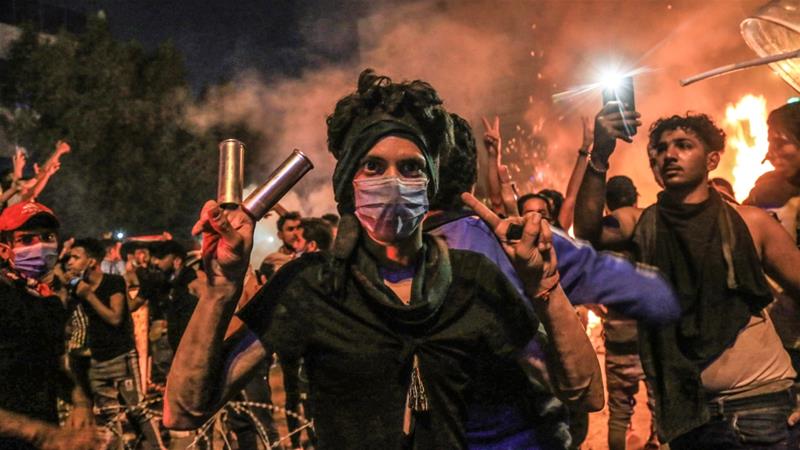

Iraq’s security forces fired live ammunition early on Tuesday to disperse an anti-government demonstration in the southern holy city of Karbala, killing at least 14 protesters and wounding hundreds of others, medical sources said.
But Karbala’s police chief denied in a statement that any protesters had been killed and said only one person died in an unrelated criminal incident, calling footage of security forces shooting at protesters on social media fabricated and designed to “incite the street”.

Security officials said the violence happened in Karbala’s Education Square, about two kilometres (1.2 miles) from the Imam Hussain Shrine, where demonstrators set up tents for their sit-in.
A witness said hundreds of protesters were in the encampment when live rounds were fired towards them from a passing car.
Then masked gunmen in black plainclothes arrived and started shooting at the demonstrators, the witness said, speaking on condition of anonymity, fearing for his safety. Tents caught fire, igniting a blaze, he added.
Karbala’s Governor Nassif al-Khattabi denied reports about Iraqi protester deaths. “Security forces have exercised utmost restraint,” he said.
Read Also:
The governor accused protesters of “carrying weapons and an internationally prohibited bomb”, without elaborating.
Karbala Police Chief Ahmed Zweini accused protesters of hurling petrol-bombs at security forces.
Iraq’s High Commission for Human Rights, meanwhile, revised an earlier statement in which it said 18 people had been killed, saying only one demonstrator died and 192 others were injured.
Later on Tuesday, a Reuters news agency correspondent saw a convoy of anti-riot police driving towards Baghdad’s central Tahrir Square where protesters, now joined by students, gathered for a fifth day.
The renewed protests in Iraq came weeks after an earlier wave of rallies broke out as a result of widespread anger at high-level corruption, mass unemployment and poor public services. More than 250 people have been killed in this month’s demonstrations in the capital Baghdad and several southern cities.
Many Iraqis blame a political elite they say is subservient to one or another of Baghdad’s two main allies, the United States and Iran. They say these powers use Iraq as a proxy to pursue their struggle for regional influence, without concern for the needs of ordinary people.