
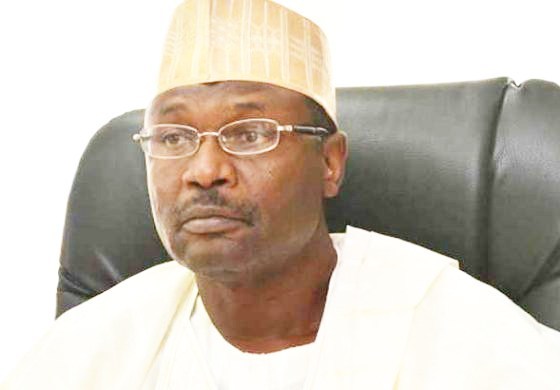

MOSES ORJIME writes on the continuous decrease in the number of eligible voters during elections since 1999.
With every election cycle, the number of Nigerians who vote has repeatedly shrunk in spite of the ever growing number of registered voters. This has been the pattern since 1999 when Nigeria returned to democratic rule. And the 2019 general election is no different.

Between the last election in 2015 and 2019, 16.58 million Nigerians, according to the Independent National Electoral Commission (INEC) became eligible to vote for the first time. Yet preliminary figures of that number of people who took part in the 2019 elections showed a shrinking voter base.
Collations by INEC in states such as Abia, Enugu and Ebonyi, Rivers, and some others witnessed the lowest turnout, with less than 30 percent of their registered voters marking the ballot.
This is in stark contrast to 1999 when 70 percent of all registered voters turned out to usher in Nigeria’s new democracy.
In 2015, the lowest turnout was as a result of issues such as voter apathy and the heavy activity of Boko Haram in the North East.
In 2019, the continued insurgency, in some affected states such as Borno, Yobe, Zamfara, Sokoto, Bauchi and others, which were affected by Boko Haram and Herdsmen attacks surprisingly recorded the higher voter turnout for 2019 general elections.
However, going through the analysis of official records obtained from the website of the INEC, it was revealed that 52.3 per cent of registered voters voted in the 1999 elections.
The figures rose to 69.1 percent in 2003, then went down to 57.4 percent in 2011, 53.7 percent in 2011 and 43.6 percent in 2015.
Between 1999 and 2019, Nigeria’s registered voters rose from 57,938,945 to 84,004,084.
In 1999 polls, the South-South had the highest valid votes of 4,227,330, followed by North West 3,884,836, North Central 3,615,793, North East 3,552,353, South East 2,307,772, and South West 1,902,196.
In 2003 elections, the North West led with 9,643,772 valid votes, followed by the South-South 7,673,448, North East 6,237,877, North Central 5,739,206, South West 5,698,907, and South East 4,550,279.
During 2007 elections, the North West had the highest valid votes cast totalling 8,867,128; followed by the South South 6,770,546, North Central 6,494,860, South West 4,349,730, South East 3,673,274, and North East 3,114,413.
In 2011, the North West again, led other zones with the highest valid votes of 6,844,836, South South 6,197,404, North Central 5,052,348, South East 5,044,923, South West 4,553,999, and North East 4,814,167.
In 2015, the North West had the highest valid votes of 8,505,577, with the South South following with 4,667,879, South West 4,362,456, North Central 4,149,143, North East 3,672,348, and South East 2,719,654.
History of voters’ turnout
In 1999, there were 57,938,945 registered voters by INEC. However, the total votes cast was 30,280,052, representing 52.3 percent.
There were 29,848,441 valid votes and 431,611 invalid votes, representing 98.6 percent and 1.4 percent of the total votes cast respectively.
However, the voter turnout rose in 2003 to 69.1 per cent. That year, INEC had 60,823,022 registered voters, out of which 42,018,735 turned out and cast their votes with 39,480,489 valid votes and 2,538,246 invalid votes.
The turnout in 2003 represented an increase of 16.8 percent.
In 2007, available records showed that there were 61,566,648 registered voters by INEC out of which 35,419,262 voters, representing 57.4 per cent, were said to have been voted. This represented a drop in the voter turnout of 11.04 percent.
The voter turnout again dropped further to 53.7 percent in the 2011 presidential election when INEC had 73,528,040 registered voters, but only 39,469,484 of them turned out for the poll, with 38,209,978 valid votes and 1,259,506 invalid votes. This represented a drop of 4.36 percent.
The situation was the same in 2015 when only 29,432,083 voters, which was 43.6 percent out of the 67,422,005, registered voters turned out and cast their votes. That year, there were 28,587,564 valid votes and 844,519 invalid votes. The drop was 10.1 percent.
Many reasons have been given for this trend and the impact it will have on the quality of democracy the country will experience. Ranking high in the reasons why eligible voters do not come out to vote on election day is the fear of violence.
Dozens were victims of yet another round of decade-old bombings by Islamic militants up north in Maiduguri, capital of Borno State, while brutal killings reigned down south in the oil-rich Rivers State, as reports of sporadic violence piled across Nigeria amid Saturday’s Presidential and National Assembly polls.
People were killed and in milder cases battered and injured, while election materials were set ablaze by armed bandits and voting delayed for hours in some polling centres mainly in southern Nigeria.
Read Also:
Situation Room, a coalition of more than 70 civic groups monitoring the election process, said it observed violent disruptions by political thugs that snatched and burnt ballot boxes and papers. The group reported that 16 people were killed in electoral violence across eight states, six of the people from Rivers State alone.
YIAGA in a preliminary report signed by its Communications Officer, Moshood Isah, which was released in Abuja on the recent election said this reflects a growing sense of disconnect between the political class and the masses.
The report read in part, “YIAGA AFRICA notes that turnout for the 2019 elections falls below the bar set in 2015. This reflects the growing sense of disconnect between the Nigerian people and the political elite.
“YIAGA AFRICA calls on all major political parties, regardless of the outcome of the polls , to review their platforms and communication strategies to better align their policies and actions with the interests of their constituency.
“YIAGA AFRICA also encourages parties to deepen their internal party democracy through the organisation of more transparent and open primaries and to make active efforts to attract and promote candidates who better reflect Nigeria ’s diverse population , including youth, women and people with Disabilities candidates. Candidates should emerge as through an open competition between ideas and policies rather than through an auction to the highest bidder .”
The group also lamented that INEC’s performance was not as good as previous years.
It said when the commission postponed elections by a week , most Nigerians expected that INEC would be more prepared but Saturday ’s elections was characterised by late arrival of electoral officials, materials and subsequently late voting .
YIAGA added , “The February 23 Presidential election was characterised by many of the same shortcomings that have marred previous national elections in Nigeria . As in past elections , INEC ’s logistical challenges and misconduct by political parties undermined the integrity of elections and the ability of some citizens to vote.
“These issues do not necessarily undermine the overall credibility of the process , but Nigeria missed an opportunity to improve the quality of its elections as compared to 2015 national elections . These were not the elections Nigerians wanted ; they were not the elections Nigerians expected ; and most importantly , they were not the elections Nigerians deserved.
A political scientist in the department of political science Ashi Polytechnic Anyiin Logo, Benue State, Terhile Isaac, told LEADERSHIP Sunday that in the 2019 general election so far, the low voter turn out may be as a result of the initial cancellation of the polls. It was earlier scheduled for the Febuary 16, 2019, and eventually rescheduled for February 23, 2019.
He also said the violence experienced in some states in the build-up to the 2019 elections was also responsible.
First, he said, there are a lot of threats to the lives of voters, “especially with recent happenings around the country where violence has erupted in a number of places during and after campaigns.”
He said another factor that may make a lot of voters not to turn out for the polls, was the fact that the political parties did not convince Nigerians about their programmes and policies if voted into power.
Also, a member of Alliance for Democracy (AD), Stephen Mondo, said that there is low voter turnout because elections are becoming so violent and nobody wants to loose his or her life.
“You know politicians are so desperate, even the electoral process is not credible and the whole process has become a do or die affair, killings among other things are some factors discouraging people from voting.
“People turned out to believe that even if they vote, their vote will not be counted.
According to him, INEC delayed the election day by a week because of logistical problems which sparked complaints from people who had already travelled to their hometowns to vote, and now would have to make the journey twice.
A political scientist, Benue state University Makurdi Clement Orfega said that cases of voter intimidation and electoral violence played a role in the reduced voter turnout. The sudden postponement of the election at the eleventh hour may have also affected voter participation.
Besides the issue of violence is a propensity of the elite not to vote, which is quite noticeable during election.
Many have however decried the cumbersome nature of the electoral process for why some voters do not participate in the process. While analysts aver that no effort put into voting as an essential civic duty is a waste, some pundits have argued that the manual electoral process is time consuming.
Proponents of this change have suggested the use of electronic voting systems which has a propensity for less human error and makes manipulation more difficult.
Though there are reported cases of electronic voter verification devices failing, many believe the use of technology has helped understand the electorate and their true behaviour at the polls, as well as curb voter fraud.
Also, there is the concern of ensuring voters believe that their votes count.