
The history of the fourth republic has shown that Presidential election debates do not translate to voters choices, GABRIEL ATUMEYI writes.
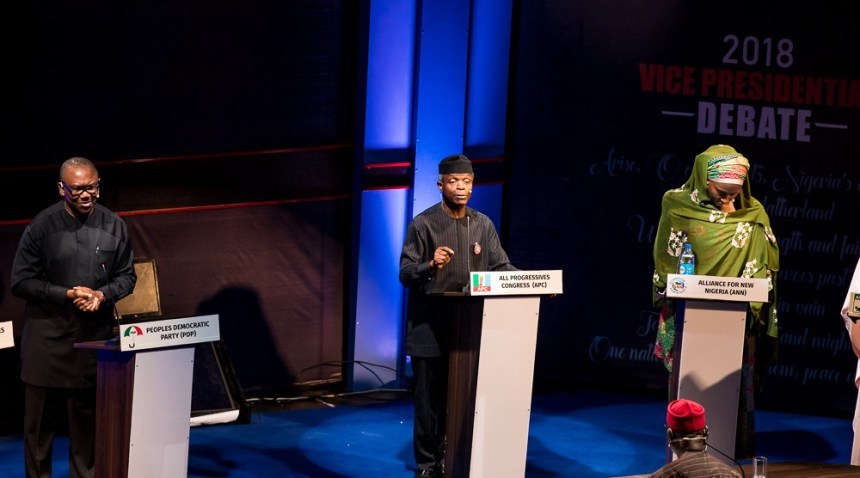
The presidential debate hosted by the Nigeria Election Debate Group (NEDG) and the Broadcasting Organisation of Nigeria (BON) have come and gone generating all sorts of controversy, ranging from why only five political parties were allowed to participate, to the conspicuous absence of the two main challengers of the dominant political parties, APC and PDP.

As the debates over these issues continue, political pundits have also weighed in on the real value of this debates, in terms of the eventual choice of the Nigerian electorates at the polls.
The presidential debate has been lauded on the one hand for enhancing the tradition of civility by bringing key contenders on a common platform for public scrutiny. On the other hand, the electoral outcome has not also reflected the performance of the candidates as it seems to be the norm in advanced democratic climes.
In virtually all the presidential elections the country has held since its return to democracy in 1999, the candidates that have won the contest were usually the ones that were absent at the debates, thus a pointer to the relative inconsequence of such an event in light of the final outcome of the election.
In 1999, only three major political parties and through political alignment, only two presidential candidates emerged – one for PDP and the other was a compromise between AD and APP. PDP presented Chief Olusegun Obasanjo – a former Head of State while the “AD/APP compromise” brought up Chief Olu Falae – a former Finance Minister and Secretary to the Government of the Federation (SGF).
Unfortunately, this enabling environment for a proper debate between the two candidates did not materialise. The debate could not hold because the PDP candidate, Mr Obasanjo who later won the election did not show up. In 2007, when there was a change of guard at the helm of the national executive power, the eventual winner, Umar Yar’Adua did not honour the invitation to a presidential debate that featured contenders like Prof Pat Utomi and Muhammadu Buhari.
Similarly in 2011, President Goodluck Jonathan who retained his hold on power did not take part at the debate that paraded the likes of former Kano state governor, Ibrahim Shekarau, Nuhu Ribadu and Muhammadu Buhari.
In 2015, when retired general Muhammadu Buhari emerged as the president of Nigeria, he was conspicuously absent at the presidential debate, even though the incumbent, Goodluck Jonathan was there.
By this trend the debate seems to be a bad omen and a platform for those desperately looking for new lease of life for their campaign, as is obvious with Goodluck Jonathan, who declined in 2011 and accepted in 2015. Or Muhammadu Buhari who was always ready to use the platform to get his message out, only to decline in 2015 at the heigth of his popularity and again on the 19th of this month.
As if conscious of the futility of the debate in persuading the electorates, the APC in a statement in the aftermath of the January 19 debate said that the party would use any platform it chooses in order to get their message out as adjudged best to them.
It added that even though the debate as fantastic as it is, is just one of the several options for their candidate to engage with the public. The party added that there are many platforms they have used and are still going to use, and that there are many that they may not use.
Apparently alluding to their lack of confidence in the efficacy of the debate in promoting their electoral agenda or may even undermine their political stature or invincibility.
Speaking on the eve of the January 19 debate, a one time Commissioner for Works in Lagos State, Ganiyu Johnson (GAJ), had reinforced the position, by saying the debate would not determine who would win the 2019 presidential elections in Nigeria.
Johnson, who recently resigned to run as the All Progressives Congress (APC) House of Representatives candidate for Oshodi Isolo II Federal Constituency, made the assertions at an interactive session with newsmen in Lagos.
According to Johnson, though the debates might have counted in other climes, in Nigeria majority of voters do not watch such debates, but vote based on benefits from governance. He said: “Debates are good for the enlightened, but you cannot use it to judge.
“Most of the viewers are not voters. You can make statistical judgment from it, but it doesn’t affect results or show voting patterns.
“How many market women or ordinary Nigerians tuned in for the debate?
“The elites who did are the ones crediting or discrediting the contestants based on their affiliations and these group of Nigerians hardly vote. Their criticisms and choices end on the internet.
“This is not to say that such debates are bad as it gives an idea of the performances of the present administration and an opportunity for the opposition parties to tell Nigerians who watch and the International community what they could have done differently.”
He however, concluded that President Muhammadu Buhari would have a landslide victory at the polls.
Some pundits have opined that a point against debates is the fact that Nigerian politicians do not in earnest have differences.
Read Also:
For them, in Nigeria, ‘someone could be in Party A in the morning, join Party B in the afternoon and by evening of the same day be contesting under Party C’s platform’. They hold that the system also allows a politician to return to his previous party even after having won an election on the platform of another party.
Others have drawn attention to the issue of politicising everything in Nigeria, making it hard to give any policy or event its true nature and meaning.
They also note that the significance of a political debate is that it offers an opportunity for all political parties to enlighten viewers and listeners on their manifestos and election promises so as to convince the public to vote for them.
It is expected that such an opportunity is expected to be enthusiastically utilised by all; particularly small or poor political parties who cannot afford huge electioneering expenses on advertisements to publicise their activities.
Rather than do that, Nigerian political parties, particularly those in the opposition, prefer to chase shadows, by leaving the debate proper for the politics of the debate.
This was reflected in the drama that trailed the recent debate which was boycotted by the two leading candidates, President Muhammadu Buhari of APC and former Vice President, Atiku Abubakar of PDP.
While the candidates who attended the debate took turns to lambast Buhari and Atiku for not showing up, the two absentee candidates in turn resorted to trading blames over their absence.
Speaking to LEADERSHIP Sunday, a public affairs analyst, Mr Jide Ojo, said the perception of debates reflects the negligent values accorded to it. He however said such assumptions should be scientific.
“The point is we don’t have to be superstitious about the presidential debate, that is that if you don’t attend you will go on to win the election. There is no empirical evidence to support that abstaining from the debate is a prelude to electoral victory.
“I think it is just that the presidential debate, one, is not mandatory, so it is discretionary, two, there is also a targeted audience who monitor or are interested in political debates, they are mostly the elites, the middle class people, the upper class people but what is the voting population of those people?
“They are about 20 to 30 percent and many of them are not inclined to stress themselves in order to vote but you will find out that the people in rural areas who form the bulk of the voting population are not going to make up their minds on the performance of candidates at the presidential debate.
“It is most likely based on primordial sentiments and cash for votes. It is about who is able to spend more. Most of these rural communities if you go there, no matter what we do during the campaign to discourage people from getting induced before they vote, the moment some of the community leaders or elders bring some materials or money to share to them and tell them this is the person to vote for, irrespective of what you say at the campaign rally, that is the person that will carry the day.
“Don’t forget that political debate is just one out of several other campaign strategies, there are those who are doing door to door campaign, neighbour to neighbour campaign, face to face campaign. There are those who are using political adverts and the social media. So you cannot zone down the actual electoral reach of the presidential debate alone. In this instance, both main challengers abstained so you cannot judge the better candidate or know who will win.
“So are you saying that the two of them will win at the same time? The point is that the two main candidates of which one will emerge victorious did not participate, it tells you that there are some factors and variables responsible for electoral victory beyond political debates.”
Also speaking to LEADERSHIP Sunday, the national publicity secretary of the People’s Democratic Congress (PDC), Hon Philemon Okoye, said the presidential debate is very necessary because it affords the electorates the opportunity to assess the candidates and allows those that have been elected to come to their own scorecard.
“ You cannot be doing a wrong thing and be eulogising it, Nigeria is progressing, people are developing, we would want to attain the kind of democracy we have in Europe and America, where you can easily assess your leader.
“So for me, in the past that they didn’t show up what was the electoral process like? In a free, fair and credible election, the presidential debate will go a long way to determine who wins. Buhari not attending the debate has left a lot of vacuum, because people wanted to see what and how they will perform, that is between Buhari and Atiku Abubakar. Right now people feel that Buhari does not have what it takes.
“The one they organised and attended, he didn’t perform well because there were a lot of mitigating factors affecting his performance, of which health is also one of it. It shows clearly that he doesn’t have the capacity to run the election. So any right discerning mind from that debate can easily know that Buhari, even though he talks about credibility doesn’t know what it takes to move the country to the next phase.
“So the presidential debate is very necessary, without the APC rigging this election, if they allow the election to be credible, with INEC as an unbiased umpire, I am telling you from what we have seen so far, Atiku Abubakar stands a better chance. Let us be clear without the president it is no longer a presidential debate.