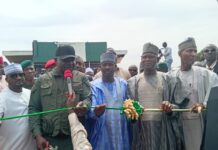


The United States Agency for International Development (USAID), in partnership with the Ministry of Agriculture, Animal Industry, and Fisheries (MAAIF), launched on August 14 the first of four training workshops focused on value chain analysis as a valuable tool for increasing agricultural productivity. The trainings, which are delivered through USAID’s Feed the Future Commodity Marketing and Production Activity, will reach more than 100 agricultural officers countrywide. The trainings will take place in Jinja (August 14-15), Masaka (August 17-18), Mbarara (August 21-22), and Gulu (August 24-25).
Transforming Uganda’s agriculture requires that Ugandans be in the driving seat to scale up proven models such as the village agent model
The training workshops represent part of an ongoing USAID-MAAIF partnership to integrate the tested and proven market-led “village agent model” into the Government of Uganda’s agricultural extension system. To do this, the trainings introduce agricultural officers to the village agent model, which aims to improve and complement Uganda’s agricultural extension service delivery system.

USAID anticipates that the knowledge the MAAIF agricultural officers receive will empower them to promote the model to additional farmers and traders. More importantly, the trainings should help to ensure that smallholder farmers increase production and income from the range of services offered through the model.
USAID Mission Director Mark Meassick said, “Transforming Uganda’s agriculture requires that Ugandans be in the driving seat to scale up proven models such as the village agent model, which has proven to be cost effective and efficient in delivering production and marketing services to farmers.”
Implemented through USAID, Feed the Future is the U.S. Government’s global hunger and food security initiative that aims to spur economic growth; increase incomes; and reduce hunger, poverty, and under nutrition. Feed the Future also features the cross-cutting priorities of gender equality, expanded opportunities for women and girls, and environmentally-sustainable and climate resilient agricultural development.