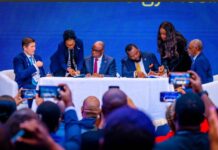


The Executive Secretary of the Presidential Advisory Committee Against Corruption, Prof Bolaji Owasanoye, yesterday in Lagos revealed that 55 Nigerians allegedly looted N1.35 trillion from the country in seven years.
Speaking during an interactive session with the media and civil society organisations (CSOs) to mark the committee’s first anniversary, he said corruption has been one of the most damaging obstacles to the development of Nigeria.

According to him, “Using the World Bank’s rates and costs, one-third of this stolen amount could have provided 635.18 kilometres of roads, built 36 ultra modern hospitals (one per state), built and furnished 183 schools, educated 3,974 children from primary level all the way to tertiary education (at N25.2 million per child) and also built 20,062 units of two-bedroom houses.
“Corruption is Nigeria’s greatest challenge and is directly associated with the current economic decline, high poverty rate, reduced life expectancy, mortality and the deteriorating living standards experienced by citizens.
“Beyond its developmental implications, the promotion and strengthening of democratic institutions and values are diminished; corruption is the enemy of development and good governance.”
He added that the crusade against corruption on the side of the federal government went comatose from 2007 largely due to a leadership deficit.
“In fairness to President Umaru Yar’Adua, his health challenges prevented him from defining his stance against corruption, although it must be acknowledged that he publicly declared his assets.
“President Goodluck Jonathan fared far worse than his predecessors in tackling corruption. His tolerance for corruption was reflected in the sunset of the activities of the anti-corruption agencies under his watch and other exponential increase of other vices no doubt fuelled by corruption.
“For example, it is widely believed that insecurity escalated because of the embezzlement of $2 billion through the Office of the National Security Adviser (NSA) under the leadership of Col. Sambo Dasuki (rtd.), who allegedly diverted the money appropriated to fight the insurgency.
“The problem of the downstream sector of the petroleum industry reached a zenith with multi-billion dollar subsidy scams while President Goodluck Jonathan looked the other way.
“At the same time, other vices spread like cancer kidnapping, import duty waivers, financial recklessness, a profligate legislature, corrupt judiciary, etc. There was no single high profile conviction for corruption under his watch yet there were allegations of high profile corruption within the cabinet.
Read Also:
“Jonathan’s legendary comment that stealing is not corruption underscores his perspective on corruption and remains a watershed in the history of the anti-corruption crusade in Nigeria. Under his watch, corruption brought Nigeria to its knees,” Owasanoye said.
He observed that if judges strictly complied with the provisions of the Administration of Criminal Justice Act, high profile cases would be quickly determined.
According to him, rather than being firm, some judges indulge lawyers who go out of their way to delay cases for their clients by abusing court processes.
Owasanoye said: “If you do a thorough analysis of the all the high profile cases that are hanging in the courts, they are not hanging because investigations were poor. It is because the suspects are manipulating the court system.
“If you accuse me of corruption and I have a good defence, why should I want the case to go on for 10 years? I should be the one insisting on no adjournment. I would want my case quickly dispensed with so I can clear my name, but that’s not what you get.
“So while there’s need for thorough investigation, we should understand that the reason the corruption fight is slow is because of the high tolerance of the courts of the shenanigans of lawyers.
“Once the judges stamp their feet and say: ‘We’ll not entertain adjournments, these cases must proceed,’ you will see a change. We’ve seen these situations in this country before. We need to get the narrative right.”
Owasanoye noted that corruption was thriving because Nigerians had become tolerant of it, adding that the government cannot fight corruption without the public’s support.
“For as long as we tolerate corruption, it’ll continue to thrive. We need to show our revulsion for corruption,” he said.
Owasanoye said banks were part of the problem also, as they now help some ministries, departments and agencies (MDAs) to hide funds which ought to be in the Treasury Single Account (TSA).
“They do this in the name of private banking. It is a violation of the law and attack on the government,” he said.
Similarly, the Chairman of PACAC, Prof Itse Sagay (SAN) blamed judges for the delay of high profile corruption cases in court.
Prof Sagay said those who complain of rights violation when they are arrested on corruption allegations ignore the fact that the rights of millions of Nigerians have been violated through graft.
“There are social, economic and cultural rights. Each time billions of naira is looted, people’s rights to education, health and social services are violated,” he said.
Sagay urged Nigerians to join the fight against corruption, as the consequences affect everyone.
He also asked CSOs to do more to help rid the country of corruption. “CSOs of today have gone to sleep. For this fight to be effective, we need their support,” he said.
He also urged labour leaders to join the battle and avoid getting compromised.