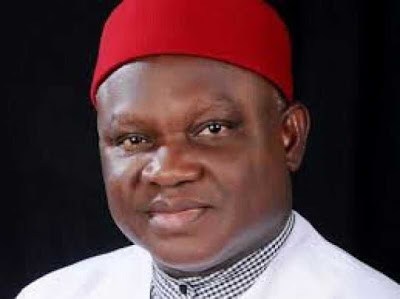

Chief Chekwas Okorie is the national chairman of the United Progressive Party (UPP) and staunch supporter of President Muhammadu Buhari’s reelection bid. In this interview with PAUL UWADIMA, he spoke on how they mobilised support for Buhari’s reelection in the South-east and other national issues.
The Pan-Igbo socio-cultural organisation, Ohanaeze has been torn apart by the 2019 presidential election, with one faction endorsing President Muhammadu Buhari, while another faction endorsed Atiku Abubakar. How do you see the future of Ohanaeze going forward?

Ohanaeze is in dilemma and Ohanaeze is divided. I saw this coming. I am one of oldest members of Ohanaeze. Ohanaeze was designed for the protection of Igbo interest, it was not designed for political purposes. But sometime certain leaders of Ohanaeze could not resist the temptation and Ohanaeze always has to pay dearly for it. At the build up to 2019 general elections, Ohanaeze under Nnia Nwodo went down the route of politicisation of the group. Ohanaeze has created problems for the geo-political zone. Ohanaeze will never be the same again because anytime there is a meeting of Ohanaeze, only PDP members attend. People like us will not attend. So this is where we are. It will take some time to clear the mess. Some of us will not attend Ohanaeze meetings until the partisanship issue is resolved. If it is resolved within Nwodo’s tenure we can review our attitude to Ohanaeze. It has nothing to do with him as a person, but he led Ohanaeze into partisanship.
You are one of the leaders of the South-east who campaigned vigorously for President Muhammadu Buhari’s reelection even when he was not a member of your party United Progressive Party (UPP). Now that Buhari has been reelected without winning any South-east state will you say that your campaign was successful or it failed?
I think we made tremendous progress and the president and his campaign organisation appreciate our input. When we announced our support, it was August last year, August 17 to be precise. And that was the NEC decision, the National Executive Committee of the UPP. At that time it was almost like a political suicide for a political leader of my standing to come out publicly to say that it is Buhari or no one else. And to underscore the fact that our party was serious about it we also resolved that we are not going to present a presidential candidate. And we adopted him as our candidate. When we went to visit him , that is the leadership of the party we made a commitment to him that we are going to work hard to change the narrative propaganda especially among the Igbo people, the Igbo people are not only resident in the South-east, they are three times the number outside the zone. So our target was not just South East. Secondly we say that we are going to ensure that his victory, we considered imminent at that time, will assume a stature of a national consensus, so that every part of the country will have a stake in it. We were disturbed by the five per cent he had in 2015. We are not claiming 100 per cent credit. There were other people that also joined us but when we started except those who are already in APC who didn’t actually have a voice we gave them the voice to campaign for Muhammadu Buhari because those Igbo people in the South-east were practically hiding their identity for fear of either being physically attacked. Now at the end of the election the South-east gave him 25 per cent in three of the five states of the South-east, that is majority of the states of the South-east. From 5 per cent to 25 per cent . In terms of number that is quite enormous.
Ahead of the inauguration of the President for second term, individuals and various zones are jostling for positions, including people of South-east, are you expecting a better deal from Buhari this time unlike in 2015 when he did not get much support from the zone?
Read Also:
I expect him to revisit some of the things he did before, because other than the number he got, which is an improvement, there is the need for national unity. There is the need for national cohesion. There is the need for equity and sense of equity. This means the President should address the issue of balanced appointments. I am not talking about only ministerial appointments; I am also including Departments and Agencies. The people of South-east cannot be said to be crying wolf , the marginalisation is obvious. It was the result of their putting all their eggs in PDP basket. Secondly no matter what happened in 2015 there should be no justification for the exclusion of South-east in the National Security Council. Their number is enormous. So you cannot come to a country in which we have Igbo people in very substantial number in all the states of the federation contributing to economic development, socio-cultural development and you have a security council and they are not represented. It rankles the ear and it is unacceptable. Even the supporters of the President including my humble self find it difficult to comprehend. Now a new dispensation is about to take off, we expect that he will address that, but it is comforting though that he has already on his own, more than on three occasions, talked about forming an inclusive government. It is very comforting. Nobody had to persuade him to do it. So it can’t be said that it was because some people are agitating. He has done that as a man of equity and a man of integrity.
Buhari did better in South-east this year than in 2015, but many believe that the zone should have overwhelmingly voted for him to be taken serious for the 2023 presidential race. How do you see the chances of the zone in 2023 given the fact that the South-west is also interested in the presidential race?
One thing you can be sure is that the constitution has made the North a critical factor in determining who wins and who does not win the presidency. So in 2023 it is also an unwritten convention that the presidency of this country will go to the South but not to be micro-zoned to any zone. When it comes to the South it now depends on how Igbo people take that office seriously. They don’t have to get it from APC but they may also have to get it from APC. But if at the end of the day the APC for the purposes of this question, which you asked, gives ticket to someone from the South-west, there will also be a party or combination of parties that will give it to the South-east. And like you have Buhari from the North-west and Atiku Abubakar from the North-east , we will now have party A for South-west candidate, and party B for South-east candidate and the determining factor becomes the North. We have had traditional political alliance with the North in the First and Second Republics and this is the very first time that the South-west is having political alliance with the North. Our own alliance with the North dates back to First and Second Republics. What we need to do is to get our acts together and we will reenact that relationship. The prospect of an Igbo president in 2023 remains very bright.
As Buhari gets set for his second term will you advice him to restructure the federation, as campaigned by Atiku Abubakar of the PDP or encourage him to devolve powers to the states and local governments?
Atiku anchoring his campaign on restructuring was a deceit. This is because there was no where in the North where the word restructuring came out of his mouth. I watched his campaign all through. He feebly mentioned it in Plateau State, that was all. But anytime he comes to the South it became his mantra. The fact that it was a bundle of deceit was not lost to somebody like Wike who at one time in an outburst told Atiku pointedly before their convention in Port Harcourt that the people of Niger Delta cannot be deceived by his restructuring campaign. That is exactly the way I feel about it. It is not in the interest of any part of the country to continue to concentrate power in one hand. Some of us who are now getting closer to him by association will continue to whisper it to his ears. You don’t get his understanding by confrontation or by hitting the streets. We will continue to raise the logic. There is also much more that the National Assembly can do. We are talking about restructuring Nigeria, which is 70 per cent, constitutional, the other 30 per cent is administrative.