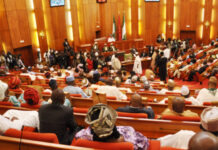


Brazil’s Senate has voted to remove President Dilma Rousseff from office for manipulating the budget.
It puts an end to the 13 years in power of her left-wing Workers’ Party. Ms Rousseff had denied the charges.
Sixty-one senators voted in favour of her dismissal and 20 against, meeting the two-thirds majority needed to remove her from the presidency.
Michel Temer has been sworn in as president and will serve out Ms Rousseff’s term until 1 January 2019.

The centre-right PMDB party politician had been serving as acting president during the impeachment proceedings.
During his first cabinet meeting since the vote, Mr Temer said his inauguration marked a “new era”.
He asked his ministers to “vigorously defend” the government from accusations that Ms Rousseff’s dismissal amounted to a coup d’etat.
“We can’t leave one accusation unanswered,” he said during the meeting, which was broadcast live on television.
He also told ministers to work closely with the Congress to revive the Brazilian economy. Mr Temer is travelling to China to take part in a summit of the G-20 group of major economies.

Ms Rousseff lost the impeachment battle but won a separate Senate vote that had sought to ban her from public office for eight years.
Pledging to appeal against her dismissal, she told her supporters: “I will not say goodbye to you. I am certain I can say: ‘See you soon.'”
She added: “They have convicted an innocent person and carried out a parliamentary coup.”
Venezuela’s leftist government reacted to the vote by removing its ambassador and freezing relations with Brazil.
Ms Rousseff was suspended in May after the Senate voted to go ahead with the impeachment process.
She was accused of moving funds between government budgets, which is illegal under Brazilian law.
Her critics said she was trying to plug deficit holes in popular social programmes to boost her chances of being re-elected in 2014.
Ms Rousseff fought the allegations, arguing that her right-wing rivals had been trying to remove her from office ever since her re-election.
She said that she was being ousted because she had allowed a wide-ranging corruption investigation to go ahead, which resulted in many high-profile politicians being charged
Ms Rousseff at a glance:
…Born in 1947, grew up in an upper middle class household in Belo Horizonte
…Her father was Bulgarian immigrant and an ex-communist
…Joined left-wing movement against Brazil’s military dictatorship which had seized power in 1964
…Detained in 1970 and imprisoned for three years
…Subjected to torture including electric shocks for her role in the underground resistance
…Came to political prominence as the protege of Luiz Inacio Lula da Silva, who governed Brazil from 2003 to 2011
…Sworn in as Brazil’s first female president in 2011
…Re-elected to a second term in 2014
…Impeached on 31 August 2016