
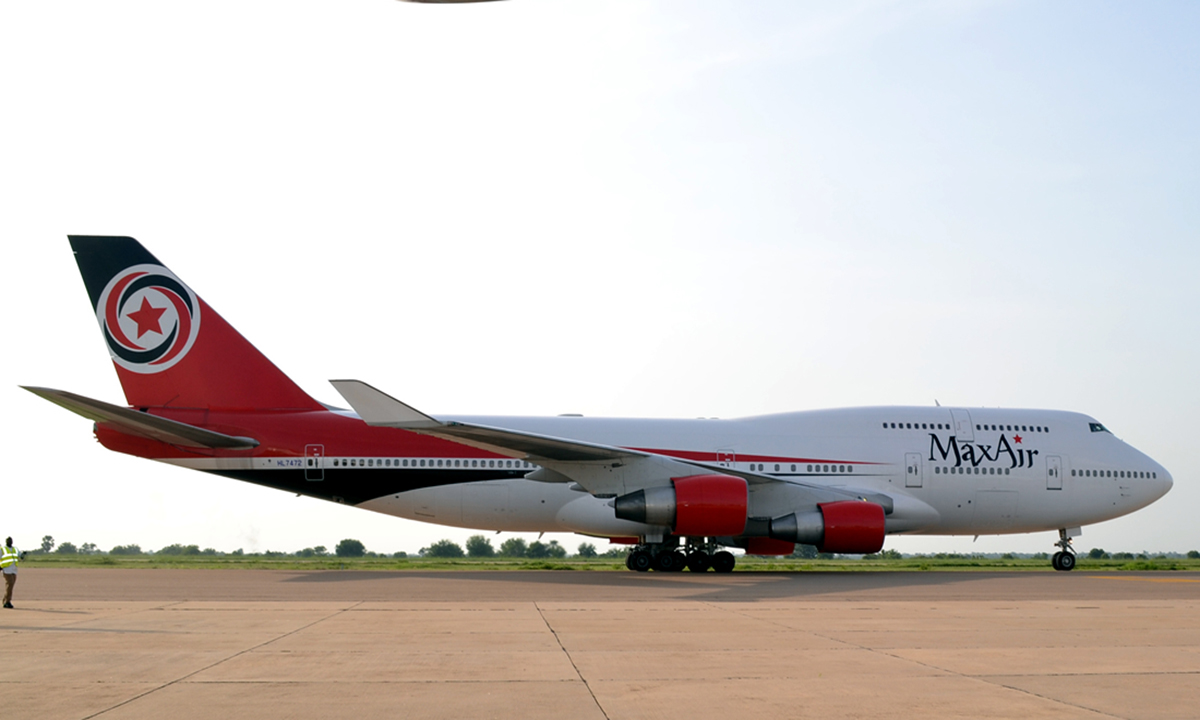


[FILES] Airplane. Photo: Maxair

Irked by the under performance of the sector in 2018, stakeholders have charted path to improved aviation industry in the New Year, placing emphasis on the imperatives of business-friendly environment.
The experts though called for supportive aviation policies and their implementations, they asked for low level of government’s bureaucracies and interference in regulatory functions.
Specifically, the stakeholders sought holistic improvement and maintenance of infrastructure, fresh opportunities for local experties, take-off of the proposed new national carrier and concession of airports to reposition the sector and maximise both local and international opportunities.
More positive outlook for global aviation
Generally, the 2019 industry forecast recently released by the International Air Transport Association (IATA), projected that all regions, except Africa, are expected to report profits in 2019, with the global net profit to reach N12.8 trillion ($35.5 billion).
IATA, the clearing house for about 290 airlines worldwide, estimated another bleak year for Nigeria and other African airlines, putting the estimated loss at N108 billion ($300 million). The report noted that the N108 billion net loss projection is a slight improvement from the N144 billion ($400 million) net loss in 2018. The expected net loss per passenger is N1,264 ($3.51).
“This makes Africa the weakest region, as it has been over the past four years. Performance is improving, but only slowly. Losses are expected to be cut in 2019 as fuel prices decrease. The region benefits from higher-than-average yields and lower operating costs in some categories. However, few airlines in the region are able to achieve adequate load factors to generate profits,” the report read in part.
Infrastructure upgrade most critical
The Aviation Security Round Table Initiative (ASRTI), a think-tank group of the local sector, noted that Nigerian airlines would continue to lag behind like most African airlines without an adequate political and infrastructural support.
President of the group, Dr. Gbenga Olowo, reflected that the 2018 indeed witnessed modest efforts by the government, its agencies and practising stakeholders.
Olowo added that airport, airlines and the airspace experienced some growth with accident investigation reports delivering maximally.
“These efforts should translate more into good results during 2019 in spite of being the election year faced with strong apprehension. Since 2014, aviation business outcome in Nigeria has been on the decline year-on-year. This is basically due to economic recession and difficult environment of doing business despite efforts of government to ease the process; no thanks to the bureaucrats and their different agenda, especially hinged on security,” he said.
Nevertheless, Olowo added, Nigerian aviation market remain strong and good for investment.
But going forward, “the government at the centre should remain focussed at stimulating private sector driven aviation sector during 2019. Airport concessioning remain only in statement over four years. Action is required against existing airport government monopoly.
Read Also:
“The Lagos Airport deserves much more attention in terms of growth strategy, intermodal connectivity and top of the rank security and technology apparatus. Because, Lagos is a natural West African hub and currently generates 60 to 65 per cent revenue; sustaining the remaining unviable Nigerian airports.
“The new international airport in Abuja that was delivered by government as Christmas Gift must not be one of those commonwealth wastages, consequent upon poor or lack of scheduled maintainance. Air Conditioners, toilets and baggage conveyor belts and so on must function in 2028 as they are in 2018 when the terminal was commissioned. Airports, airlines, and airspace must grow simultaneously,” Olowo said.
Clear-cut policies as must
Aviation Security consultant, Group Capt. John Ojikutu (rtd), said it was quite disturbing to keep running the aviation industry without any clear-cut policy amid too much interference.
“Do you know of any government’s policy? Most of the times, there is no policy. It is when issues happen that they start talking about it. Rather than derive regulations from policies, it is the reverse around here. And that is the way I have found it in the last 10 years.
“The main problem we have is that there is too much government’s interference in operational issues that we should have left in the hands of the public and private sector while strengthening the regulatory agencies to perform to the optimum without interference by the government.
“Now, there are too many private operators in the systems that have godfathers somewhere, either in the National Assembly or in the political circuit. They do not allow the oversight of the regulators to work on both private and public sector. And when you find out why, it is because of the money everyone is making from it. And until we really correct this, we are not yet ready to develop the sector,” he said.
Aviation as infant industry
Industry expert and consultant, Chris Aligbe, also opined that the industry is still at its infancy and must be treated as such for proper effect.
Aligbe said though the government had lately given some assistance to the sector, so much still needed to be done to help the industry, especially the airlines to come of age.
“For me, the industry is not asking government the right questions. I have said it over and over, this industry is still at its infant level and what to be done is to declare it as an infant industry. That way, there are privileges that will accompany it as an infant industry.
“For instance, government can create funds that the industry can access; not just things like intervention funds. There can be funds at single digit interest rates. Today, the airlines cannot borrow at double digit rates. No airline will survive at 21 or 25 per cent interest rate. That is a killer but single digit rate is okay.
“The businesses can even be protected by regulations that allow the airlines some tax-free holidays. The system can even allow indebted airlines some period of grace to come out of the indebtedness like Chapter 11 provides for in the United States. We don’t have that here but we can have a body of benefits or incentives, within which an airline can grow.
“Government can also look at charges of the agencies from airlines as a means of helping the latter to survive. A new airline can be allowed to pay just 50 per cent if the charges for the next five years to gain stability and come up. If you cannot survive that five years, then it means you cannot outgrow infancy. Also, infrastructure should be improved to keep airplanes flying round the clock instead of being on ground and losing money,” Aligbe said.