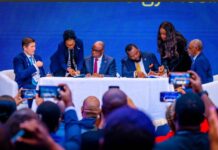


President, CITN, Chief Cyril Ede

• As tax office reveals plan to grow country’s revenue
Budget and tax experts from across the country, who yesterday gathered in Abuja, have expressed serious concern over loopholes in Nigeria’s budgeting system.The experts, primarily members of the Chartered Institute of Taxation of Nigeria (CITN), were specifically worried about rising budget implementation challenges, the gap between federal and state governments revenue, tax reforms and fiscal projections as well as the disconnect between the private and public sectors.
The Vice President, CITN, Olajumoke Simplice, who was at the event focused on, “Meeting Expectations of 2018 Budget: The Roles of Stakeholders,” said although the budget remained a key guide to the growth and development of countries, including meeting the needs of citizens, the reverse has remained the case in Nigeria.
Simplice insisted that the failure in the country’s budgeting system would drastically affects the nation’s growth projections, adding that there were clear indications that the proper implementation of 2018 budget would remain elusive.
Read Also:
“The Constitution states specifically what the government is supposed to do for the citizen; a budget that does not take care of the citizen is a failure, because it is the budget that is supposed to guide the economy, guide growth, create jobs; without that we cannot move forward,” she said.
Other stakeholders present included the President, CITN, Cyril Ede; President of Times Economics Limited, Okiti Ogoh; Director, Research, Lagos Chamber of Commerce and Industry (LCCI), Vincent Nwani; Partner, Tax & Regulatory Services, PWC, Taiwo Oyedele; Coordinating Secretary, Tax Appeal Tribunal, Muhammad Abubakar; and the Chairman of CITN, Abuja & District Society, Ogbeide Benjamin.
The players were equally worried about the gap between the budget and the needs of Nigerians, stressing that with only about 30 per cent of the financial plan going into capital expenditures, the national budget had not aided economic realities and standard of living in the country.
Nwani on his part noted that unless there is collaboration between the private and public sector, implementation of budgets in Nigeria would remain a mirage.
“Our budget is always late. We need to address the dichotomy between the National Assembly and the executive. Considering approving and signing the budget have been a problem. We have to move away from relying on oil to non-oil sources of funding budget.
“We need to make sure that moving forward, it is not just salary and wages. Recurrent expenditure takes 70 per cent of our budgets; we need to increase our capital expenditures. We also need to scrutinise the quality of capital expenditure,” Nwani said.
Meanwhile, Abubakar disclosed that government has been making efforts to increase revenue to meet up with the implementation of the 2018 budget.According to him, the Federal Inland Revenue Service in collaboration with state revenue boards had put strategies in place for optimum revenue collection across the country.
He noted that the board would be working on voluntary compliance, adding that the revenue office had achieved about 75 per cent of the targeted revenue.He noted that the agency had gone electronic to as part of its strategies to increase revenue into government coffers.Ogoh, who delivered a lecture on “Addressing Implementation Challenges of 2018 budget,” raised the alarm over the country’s worrisome debt profile.He noted that despite the executive order signed by government on timely submission of budgets across agencies, the offices had continued to breach the order thereby delaying the budget unnecessarily.
Source: G Business