
In this report, MUYIWA OYINLOLA writes that postponement of general elections in Nigeria is sadly becoming a norm, advocating for a reform that will change the tide
Nigerians on Saturday, February 16 woke up to learn about the cancellation of the much publicised Presidential and National Assembly elections.

Events in the week preceding the cancellation of the elections were a mixture of hope and hopelessness about the possibility of the polls being held.
Whereas the electoral umpire, the Independent National Electoral Commission (INEC) had announced its readiness for the elections and the subsequent Governorship and Houses of Assembly elections, earlier fixed for Saturday, March 2; and had even commenced the distribution of sensitive election materials across the country, there were certain sinister developments associated with the exercise in certain areas.
There were reports of burning of Permanent Voter Cards (PVCs) in Abia State INEC office, burning of INEC office in Anambra State, burning of vehicles convening sensitive materials meant for the elections, among others.
But not many Nigerians had the premonition that these could lead to its cancellation or postponement.
Apart from the poignant issues associated with election materials, there were also court judgements and counter-judegments concerning the listing or otherwise of candidates of the ruling All Progressives Congress (APC) in Rivers and Zamfara states on the ballot papers, following protracted intra-party crises.
However, while announcing the postponement of the elections in the wee hours of the Election Day,
INEC chairman, Prof. Mahmood Yakubu said the commission arrived at the decision following a review of its preparations which according to him indicated that conducting the election last Saturday was no longer feasible.
Hence, he announced new dates for the elections, noting that Saturday, 23rd February, 2019 has been fixed for the Presidential and the National Assembly elections while 9th March, 2019 has been fixed for the governorship, state Houses of Assembly and the Federal Capital Territory (FCT) Area Councils elections.
He further stated that the postponement would help the commission to conduct credible and successful elections.
Moreover, while addressing election stakeholders barely eight hours after the cancellation, at the International Conference Centre (ICC) in Abuja, Yakubu added that bad weather, sabotage, and a host of other factors also contributed to the postponement.
Accordingly, he stated that some materials were not delivered in due time because of bad weather, stressing that such materials that should have been flown by air, had to be transported by road. Hence, there was delay.
He also noted that there had been attempts to sabotage the efforts of the commission as seen in fire incidents that occurred at the commission’s offices in Abia, Plateau and Anambra states.
Meanwhile, a civil society organisation, Centre for Transparency Advocacy (TCA) said that the postponement is in the best interest of the country.
The group, according to a statement signed by its Acting Executive Director, Faith Nwadishi, noted that rather than having staggered elections which would not have guaranteed a free, fair and credible election, it was better the elections were postponed.
It also listed some unforetold challenges that INEC was suddenly confronted with, including the recent burning of its offices and materials in some parts of the country as well as reports of disappearance of sensitive materials, deployment of ad-hoc staff, and other such challenges that would have marred the credibility and outcome of the 2019 general elections.
While urging all stakeholders to “remain calm and not be deterred by this necessary set back towards getting it right”, it called on the commission to be more circumspect and pro-active in managing her logistics challenges.
It also noted “the shift in election dates just about five hours to the opening of polls is not good enough. The implications on the economy and citizens’ resources and time are negative”.
Nwadishi, who later addressed journalists, along with some other members of the group, in Abuja Saturday also called on INEC’s management to ensure that proper investigation was done while ensuring the prosecution of any official found wanting.
“We note the challenges INEC has to surmount such as the recent burning of INEC offices and materials in some parts of the country and reports of the disappearance of sensitive materials and deployment of ad-hoc staff.
“There is no way elections could be conducted like that. We are aware that people and observer groups have committed resources; Nigerians have made commitments, people had to cancel social events because we are all committed to having a democratic Nigeria where elections work.
“We want to ensure the right thing is done and to sound a note of warning to desperate politicians. We are Nigerians and we believe in the project Nigeria. Nigeria is not made for the 10 percent of the political class that think they have the right to distort the progress we are making in this country.
Read Also:
“Nigerians should see the handwriting on the wall and realise that the irresponsible act of the political class will not take us to where we want to get to. These challenges would have marred the credibility and outcome of the general elections,” she said.
Past Postponements
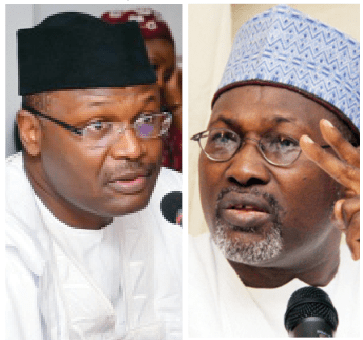
It will be recalled that in 2011, the general elections were also postponed. But unlike the situation at the weekend, voting was already ongoing in some places in the early hours of April 2, by the time the then INEC chairman, Prof. Attahiru Jega, announced the discontinuation of the exercise due to unavailability of materials.
In fact, the exercise also failed to hold on its rescheduled date, Monday, April 4, as it was further postponed to Saturday, April 16, 2011, for the presidential elections and April 26, 2011 for the state Houses of Assembly and governorship elections.
It was not only the 2011 general elections that were postponed, the 2015 general elections also suffered the same fate.
The commission announced the postponement of the 2015 general elections a week ahead of the scheduled time, citing insecurity as its reason.
Hence, Jega noted that: “Consequently, the Commission has decided to reschedule the 2015 general elections thus: the national elections (i.e. Presidential and National Assembly) are now to hold on March 28, 2015; while the state elections (Governorship and State Assembly) are to hold on April 11, 2015.”
However, two subsequent postponements, analysts had expected that the current leadership of the commission would have employed foolproof strategies to ensure elections are held as scheduled, especially as Yabuku had boasted over time that the elections would not suffer the same fate as witnessed in the 2011 and 2015 polls.
Panacea To Postponement
While speaking on the excuse given for the postponement of the 2019 polls, Lagos lawyer, Femi Falana (SAN) faulted the reasons given for the postponement, stating that there is no legal basis for shifting elections on grounds of logistical and operational inadequacies.
“Postponement of elections for logistical and operational reasons cannot be justified under the electoral law applicable in Nigeria,” he said.
“Since the country is not a Banana Republic, the law never envisaged a situation whereby elections would be shifted on account of inadequate preparations by the electoral management body.
“Hence by virtue of Section 26 of the Electoral Act, an election can only be postponed if a serious breach of peace or violence is likely to occur or on account of natural disaster or other emergencies.
“To prevent any abuse of power, the reasons for postponement must be cogent and verifiable”, he stressed.
Meanwhile, the Socio-Economic Rights and Accountability Project (SERAP) has called on INEC to push for reforms of the nation’s electoral system, as a panacea to ending the perennial election postponement in the country.
The group in a statement issued at the weekend by its Deputy Director, Kolawole Oluwadare, stated that leaving such reforms for politicians to push will not achieve the desired result.
“It is clear that the current electoral process is vulnerable to corruption, but politicians would seem to have little incentive to comprehensively reform, upgrade and modernise it.
“It is unlikely that either the federal government or the National Assembly would take the steps necessary to sort out our electoral system, and improve transparency, accountability and integrity of the electoral process,” the statement read in part.
It also decried the call for the resignation of INEC boss, as being canvassed in some quarters, calling on the masses to play active roles in the fight against corruption.
SERAP said, “Calling for the resignation of INEC chairman, Professor Mahmood Yakubu, rather than addressing the root causes of the persistent postponement of elections is a blatant attempt by politicians to scapegoat the electoral commission.
“We urge Nigerians to take a more active role in the fight against corruption, including by putting pressure on the authorities at the federal and state levels and the National Assembly to comprehensively reform, upgrade and modernize our electoral system and processes. Otherwise, citizens’ right to participate in the governance system will remain a ‘hollow right.’
“Given that the right to vote is considered a part of an individual’s fundamental right to political participation, persistent postponement of elections in the country raises serious questions about the legitimacy and integrity of Nigeria’s fledgeling democracy”.
Conclusion
Considering events of recent past, the postponement of election dates is already becoming a pattern but it is not in the best interest of the nation.
INEC needs to do more to give the nation credible elections. The political class should also brace up to its responsibility of good conduct and putting national interest first.
It is important that all agencies connected to the conduct of free and fair elections, including security agencies play their role well and promptly. Hence, it is curious that no tangible investigation or arrest has been made concerning the burning of INEC offices in the affected states.