
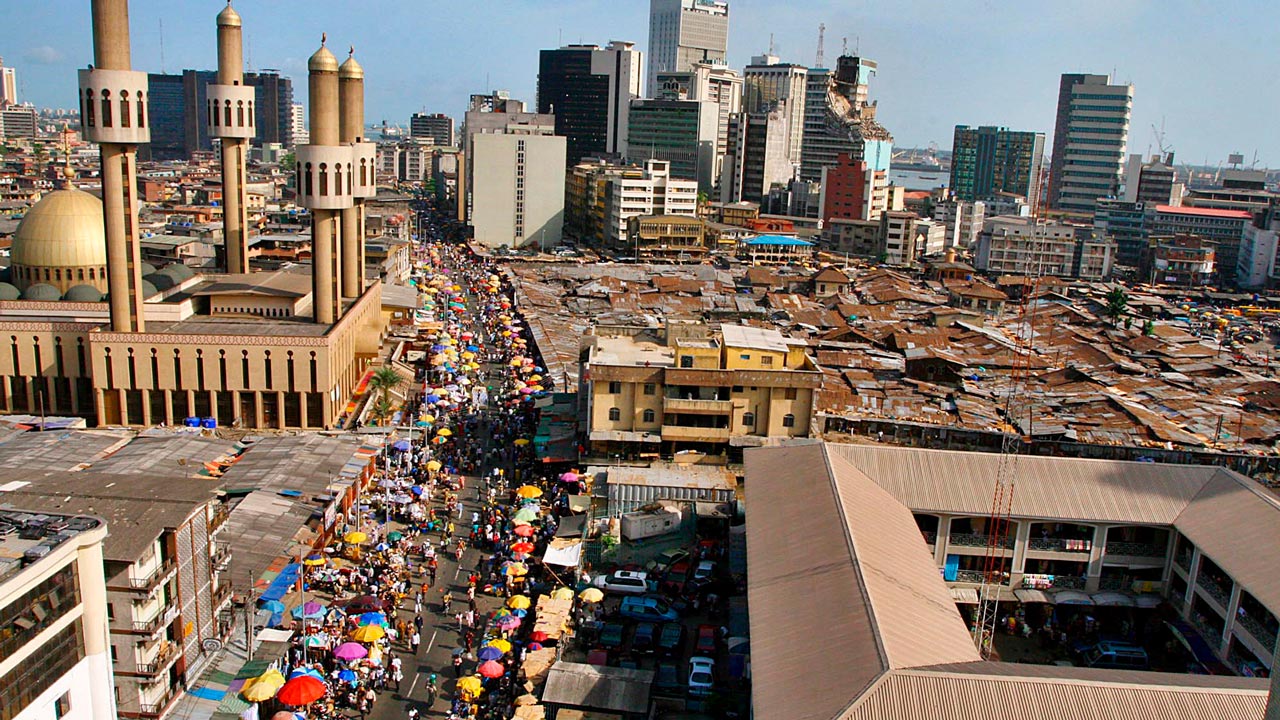


Aerial view of buildings and markets on Lagos Island.

The incidence of multiple taxes, which have crippled operations of many listed firms in Nigeria, has spawned fresh criticisms, as capital market experts at the weekend, urged the incoming administration to abolish such investment obstacle.
The experts, who canvassed a downward review of the withholding tax charged on dividend paid by quoted firms, also condemned a situation where companies that recorded losses are made to pay taxes from their turnover.
According to them, the tax system depletes returns on investment, erodes capital base of listed firms, and subsequently trigger businesses collapse.
They added that it largely undermines efforts by capital market regulators to woo more companies to list their shares in the market, a move that will make investors have access to many investment opportunities and deepen the market.
There are over 2,000 registered public companies, but less than 500 are listed on the Nigerian Stock Exchange (NSE), and this, they believe is because tax on dividend and capital gains are punitive compared to taxes on savings like bank deposits or treasury bills.
Besides, when more companies enlist, the federal government will earn more revenue in form of tax. But instead of listing and enjoying the benefits, most of them stay away from the market.
Therefore, they suggested that the incoming administration must review the tax system and multiple taxes levied on Nigerian firms to induce savings, generate high employment opportunities, and grow the nation’s Gross Domestic Product (GDP).
An independent investor, Amaechi Egbo, said: “Even though the government has in recent times moved towards a low tax regime, there is no denying the fact that current tax rates both corporate and personal are still too high to promote compliance and attract investment.
Read Also:
“Beyond being a disincentive to participation in the capital market, this situation has wider economic implications. The tax regime of quoted companies is an important tool for decision-making by multinationals whether to list or stay away from the market.
Egbo “further argued that government has not provided the needed infrastructure and amenities to justify the current tax regime in Nigeria.
A professor in the Department of Business Law, College of Law, Igbinedion University, Okada, Prof. Nat Ofo, said: “Multiple taxes are bad for businesses, as it unduly depletes the resources of companies, short changes shareholders by reducing the amount available to pay them dividend, and imposes inefficiency on companies.
“Government and regulators should provide an enabling environment for businesses to thrive. Multiple taxes are inconsistent with that objective, and should consequently be discouraged and discarded.”
The National Coordinator, Progressive Shareholders Association of Nigeria, Boniface Okezie, said: “the tax regime in Nigeria is indeed killing, what is government doing with these levies? They are not using it to better the life of the ordinary Nigerian. The infrastructure are not there; power that would enable these companies run their factory is absent, and most of these industries have no good road network, and at the end, it would affect dividend declaration and shareholders will suffer.
“The incoming government must give priority to the issues of multiple taxation, some of these companies need tax holidays in other to recoup the money invested in infrastructures so that there will be room to pay dividend to those who invested in them and employed more hands.”
The Managing Director, Highcap Securities, Imafidon Adonri, said: “Multiple taxes are a disincentive to investment; the incoming administration should abolish them.”
Agreeing, the Publicity Secretary, Independence Shareholders Association, Moses Igbrude, said not only is multiple taxes a disincentive, but also a big challenge to businesses. “This heavy tax burden ranges from FIRS, SIRS, and local governments, even thugs move around business premises collecting different levies and fines from companies, their customers and suppliers.
“All this payments hit the bottom line, making shareholders to go home without dividend at the end of every year. This is discouraging and hinders the growth of businesses in Nigeria.”