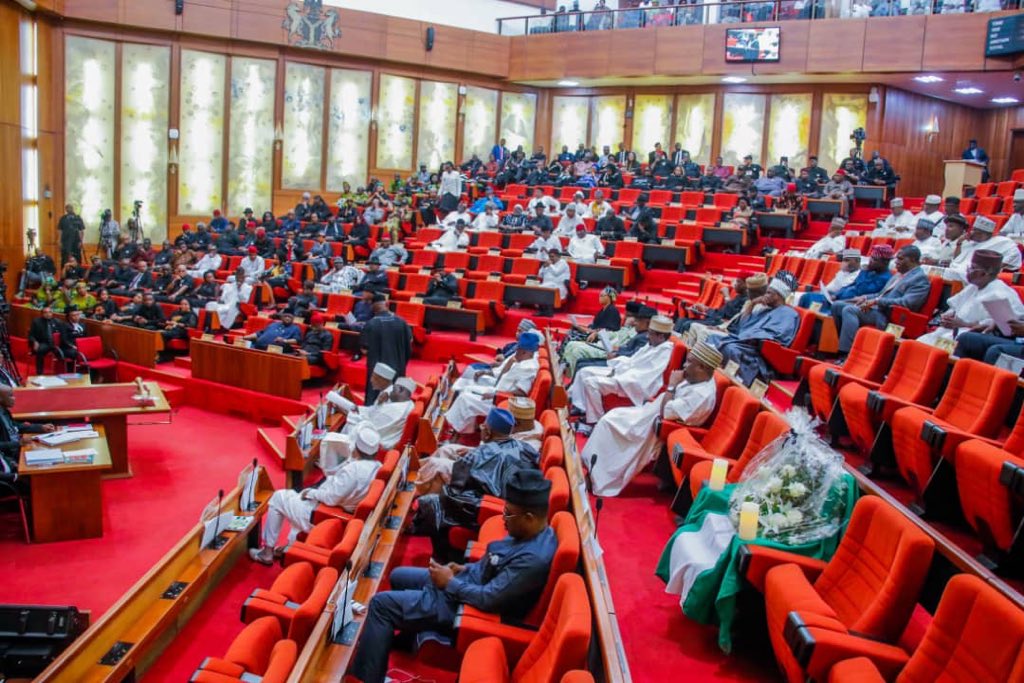

The Senate on Wednesday confirmed seven nominees of President Muhammadu Buhari as National Electoral Commissioners of Nigeria’s electoral umpire, INEC.
Those confirmed are May Agbamuche-Mbu (Delta- South-south), Mohammed Haruna (Niger – North-central, National Commissioner), Ukeagu Nnamdi (Abia – South-east, National Commissioner) A. B. Alkali (Adamawa – North-east, National Commissioner).

Others are Rhoda Gumus (Bayelsa – South-south, National Commissioner), Sam Olumekun (Ondo – South-west, National Commissioner) and Olaniyi Ijalaye (Ondo – South-west, Resident Commissioner).
Mrs Abgamuche-Mbu whose first tenure expired in September 2021 was in acting capacity when the president appointed Lauretta Onochie in October 2020, to take her place – an appointment which triggered outrage from individuals, civic groups and opposition parties who wrote petitions, staged protests and called on the Senate to reject it.
Ms Onochie, a presidential aide, was appointed to represent Delta State. Many described the appointment as unconstitutional – majorly because she is partisan and has openly campaigned for the ruling All Progressives Congress (APC).
Although she had told the Senate committee on INEC that she quit politics in 2019 and that she was no longer partisan – a claim which turned out to be false, she was, however, rejected by the Senate in July 2021.
Mr Buhari then reappointed Mrs Agbamuche-Mbu last December alongside the six other nominees.
They were were confirmed on Wednesday after the Senate considered and adopted a report by the Senate Committee on INEC.
Chairman of the Committee, Kabiru Gaya (APC, Kano), presented the report.
He said the committee received a petition from the Taraba Elders Forum against the nomination of Mr Alkali over “the seeming inconsistency in the rotation of the nomination.”
Read Also:
He said the Forum complained that the nomination started from Taraba (2003 – 2008), Adamawa (2008 – 2015) and Gombe (2015 – 2021) and it was now the turn of Taraba State to produce the nominee against the backdrop of the principle of rotation.
The Committee, however, resolved that all the states (Taraba, Adamawa and Gombe) had been nominated between 2003 and 2021, therefore, it was the prerogative of the president to pick his nominee from any of the three states.
Some senators, including the Deputy Senate President, Ovie Omo-Agege (APC, Delta Central) and James Manager, praised the competence and credibility of the nominees.
The nominees were confirmed in the Committee of the Whole.
After the confirmation, the Senate President, Ahmad Lawan, said the coming 2023 General Elections would be a “baptism of fire” to test their efficiency
He pledged that the National Assembly would support the electoral body to ensure the conduct of free and transparent elections in 2023.
He also expressed hope that the Electoral Act Amendment bill will be signed into law by the president soon, to ease their work.
“They would have a baptism of fire because 2023 is just by the corner. We expect nothing less than excellence from our electoral body,” Mr Lawan said.
“We have done this today, and INEC now has full compliment of the people that need to do the work. INEC also gets the support of the National Assembly through appropriations and, therefore, it would have no reason not to perform.
“We are also expecting that the Electoral Bill amendment will be signed, and if that happens, INEC would have a document to guide it through, even in the off season before the 2023 general elections.
“Therefore, Nigerians are expectant that INEC will perform credibly well.”