

There have been arguments by stakeholders whether the Code of Conduct Tribunal is a court or not. ADEBIYI ADEDAPO, in this report, looks at how independent it is as a judicial organ.
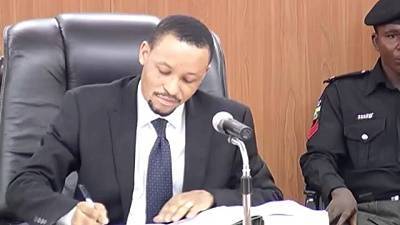
Chairman of the Code of Conduct Tribunal (CCT), Danladi Umar, last week threw up a legal argument as to whether or not the Federal Judicial Service Commission (FJSC) could query a member of the tribunal.

The National Judicial Council (NJC) had forwarded a petition against Umar to FJSC for appropriate action. Consequently, the FJSC forward the said petition to Umar and demanded his response.
Surprisingly, the Chairman challenged the powers of any organ of the judiciary to query his actions with respect to the on-going trial of the suspended Chief Justice of Nigeria, (CJN), Justice Walter Onnoghen.
Umar, who is presiding over the three-member panel tribunal that is handling the six-count charge filed by the federal government against Onnoghen, noted that he could only respond to query from the Presidency.
In his response dated February 6, 2019, and marked CCT/HQ/FJSC/S/01, Umar contended that neither the FJSC nor the NJC, has the constitutional powers to query his actions.
He noted that he is not a judicial officer and as such could not be quarried by any organ of the judiciary, but could only be called to account by the presidency.
According to him, unlike judicial officers, members of the CCT, at the time of their inauguration, take official oaths and not judicial oaths.
“With regard to the prayer of the petitioner for an appropriate sanction against the chairman, it is important to note that the chairman and members of the tribunal, not being judicial officers, are not constitutionally subject to any disciplinary proceedings by either the National Judicial Council or the Federal Judicial Service Commission but the Presidency.
“The petitioner alleged that judicial oaths were breached and that the National Judicial Council should consider appropriate sanctions. It is to be noted that the chairman and members of the Code of Conduct Tribunal are not judicial officers.
“This is predicated on the fact that the chairman and members of the tribunal, during swearing-in, only subscribe to official oaths and not judicial oaths. Therefore, not being a judicial officer, I did not subscribe to judicial oaths as alleged, ” he stated.
He also noted that it was within his powers to grant the ex-parte order that led to Onnoghen’s suspension.
Umar also made reference to a letter dated May 18, 2015, which was signed by the then CJN and Chairman of the NJC, Justice Mahmud Mohammed.
The letter marked NJC/CIR/HOC/1/74, had specifically barred members of the CCT from referring to themselves as Justices
Read Also:
The then CJN, noted that going by provisions of Paragraph 15 (1 and 2) of Part 1 of the Fifth Schedule of the 1999 Constitution of the Federal Republic of Nigeria, members of the CCT panel could not be regarded as judges.
“From the foregoing provisions, no member, including the chairman of the CCT on appointment, is a judicial officer as defined in Section 318 (1) of the 1999 Constitution as amended unless he or she has held office as a judge of the superior court of record in Nigeria, ”the letter added.
But in a sharp contrast to Umar’s position, human rights Lawyer, Femi Falana (SAN) has advised the chairman, to respond to the query issued and served on him by the FJSC.
Falana who argued that FJSC was perfectly in order when it queried the CCT chairman, noted that Umar risks removal from the Tribunal he fails to respond to the query.
The senior lawyer noted that the CCT is not under the presidency as claimed by Umar.
“If he fails to reply the query the Federal Judicial Service Commission may wish to recommend his removal from office to the National Judicial Council pursuant to paragraph 13 (a) of Part 1 of the Third Schedule to the Constitution 1999 which will in turn make appropriate recommendations to the President, ” he said.
Quoting section 36 (1) of the CCT constitution, Falana said the chairman and members of the CCT are recognised as judicial officers by the constitution.
“By virtue of section 36 (1) of the Constitution the Code of Conduct Tribunal shall be constituted in such manner as to secure its independence and impartiality, “ he stated.
Falana expressed regret that the CCT Chairman had by his action reduced the tribunal to an appendage of the President.
“It is regrettable to note that a Tribunal established by the Constitution as an independent juridicial organ of the Federation has conveniently reduced itself to an appendage of the Presidency.
“It is expressly stated in the Constitution that the power to appoint the staff of the Tribunal and to exercise disciplinary control over them shall vest in the members of the Code of Conduct Tribunal and shall be exercisable in accordance with an Act of the National Assembly, “ he added.
Falana however contends that the constitution provides that the FJSC shall advise the NJC in nominating persons for appointment and removal of federal judicial officers including the Chairman and members of the Code of Conduct Tribunal.
According to him; “Contrary to the embarrassing position of the Tribunal Chairman, Paragraph F of Part 1 of the Third Schedule to the Constitution, 1999 as amended provides that the Federal Judicial Service Commission shall advise the National Judicial Council in nominating persons for appointment and removal of federal judicial officers including the Chairman and members of the Code of Conduct Tribunal.
“Paragraph 15 of Part 1 of the Fifth Schedule to t1he Constitution provides that the President shall appoint the Chairman and members of the Code of Conduct Tribunal on the recommendation of the National Judicial Council.”
He however explained that unlike ministers and staff in the presidency, the chairman and members of the CCT cannot be removed from office by the president.