
 Govt spends two-third of revenue on interest payment
FSDH research urges urgent revenue diversification

Nigeria’s huge debt profile at N22.3 trillion is now assuming more disproportionate weight against the country’s growth and development, a situation that will dispose the nation to perpetual borrowing.
But the only solution that is practical, with improved governance, is the urgent implementation of policies that will grow and diversify the revenue base of the country to avoid imminent debt crisis.
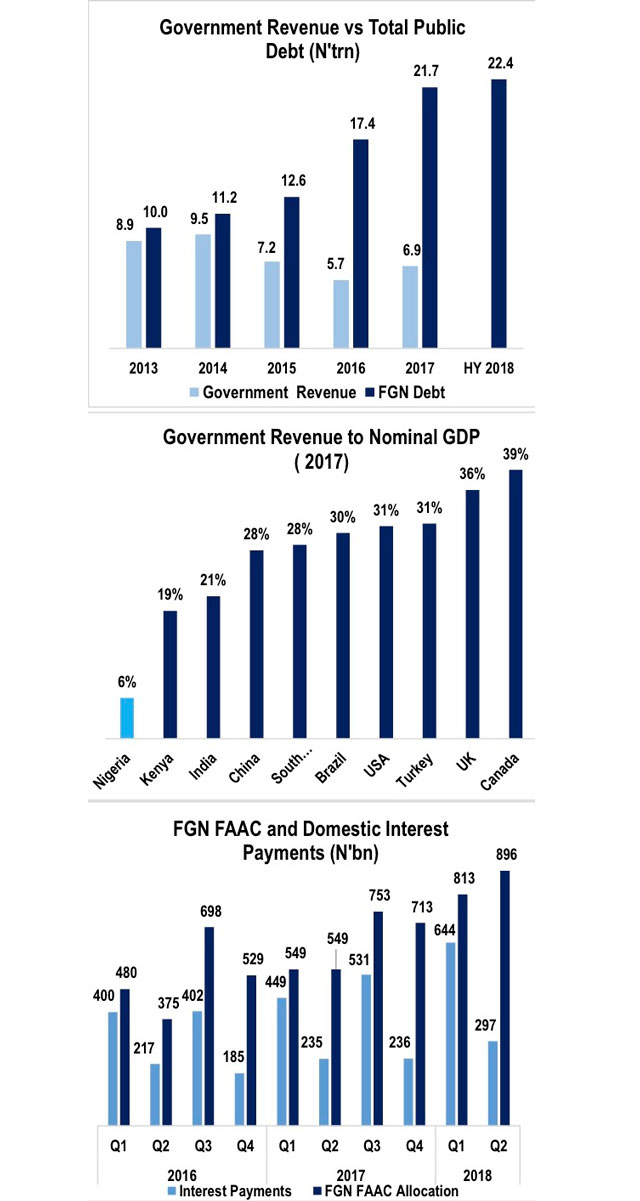
Firstly, an analysis of figures showed that the growth in Nigeria’s debt is higher than the growth in revenue and Nigeria has the lowest government revenue to Gross Domestic Product (GDP) ratio at six per cent among some selected countries.
Among the countries was Kenya, with 19 per cent revenue to GDP; India, 21 per cent; China, 28 per cent; and South Africa, 28 per cent.
But FSDH Merchant Bank Limited, in its monthly economic outlook, fingered Nigeria’s over-dependency on crude oil revenue, combined with volatility in both the price and production of crude oil as the major reasons for sluggish growth in government revenue.
The bank’s Head of Research, Ayodele Akinwuni, said growing non-oil revenue will require that the economic environment has inherent structures that can support business growth.
“Such structures include adequate physical infrastructure, policies, legal and regulatory frameworks that will make the economy business-friendly to generate taxable profits,” he said.
Secondly, an analysis of the ratio of the interest payment on domestic debt in comparison with the Federal Government’s allocation from the Federal Account Allocation Committee (FAAC), showed that the government is spending too much of its revenue to pay interest on loans, with the principal still hanging.
For example, there is a persistent significant increase in interest payment on domestic debt relative to government’s revenue from FAAC in the last three years. In 2016, while the Federal Government earned N2.1 trillion from FAAC, it paid N1.24 trillion as interest rate on local debt. In 2017, it got N2.64 trillion allocation from FAAC, but spent N1.45 trillion; while in 2018, figures available showed that it has already paid out N931 billion in interest payment on domestic debt, out of N1.71 trillion allocation.
“This leaves the government with little resources to spend on critical sectors of the economy that could support strong growth and maintain a healthy economy to generate revenue.
“The current high interest payment relative to revenue may also increase the credit risk of the country. Although the government has been able to meet its debt obligations (interest and principal payments) so far, if the current situation is not addressed, the interest rate on government loans may increase because of the perceived elevated risk.
Read Also:
“This would also lead to higher interest rates for private sector operators. It is important to note that the external environment is becoming tighter than before because of the rising interest rate in the United States,” he said.
Thirdly, an analysis of the country’s debt sojourn since 2013 showed that there has been a steady increase in the profile, with less than proportionate rise in revenue.
For example, in 2013, government revenue-to-total public debt was N8.9 trillion against N10 trillion debt; in 2014, the revenue shot up by N600 billion to N9.5 trillion, while debt profile rose by N1.2 trillion to N11.2 trillion.
However, in 2015, while the debt increased by N1.4 trillion to N12.6 trillion, the government’s revenue base lost its steam by N2.3 trillion to settles at N7.2 trillion.
It was a dramatic turn in 2016, when the debt moved from N12.6 trillion to N17.4 trillion, while revenue plunged further to N5.7 trillion, from N7.2 trillion and eventually led to economic recession.
In 2017, it was not better still, as the debt moved further to N21.7 trillion, with a marginal rise in revenue to N6.9 trillion compared to N4.3 trillion increase in debt.
So far in 2018, debt profile is currently at N22.4 trillion, with revenue projections that have been widely criticized by analysts.
For analyst at Afrinvest Securities Limited, gross revenues have significantly improved by 35.8 per cent to N6 trillion for the first eight months of the year, from N4.4 trillion in the previous year.
“However, when compared with budget expectation of N8.9 trillion, it represents a shortfall of 31.2 per cent. Also, there was a broad-based recovery in the revenue segments, but oil surged the most at 53.2 per cent to N3.6 trillion and its share of total revenues moved up 5.9 percentage points to 59.1 per cent.
“Interestingly, non-oil revenues also recorded a double-digit growth, although slower at 18.7 per cent to N2.5 trillion. Corporate taxes was the standout performer, with a growth of 31.1 per cent to N970.7 billion, while VAT and customs & excise duties also improved at 12.6 per cent and 11.2 per cent to N706.3 billion and N445.4 billion respectively,” the analysts noted.
They argued that to enthrone a more sustainable fiscal condition, government has to align its projections with revenue realities by cutting down running costs.
Also, by blocking revenue leakages in the form of unbudgeted subsidies and adopting a market-reflective exchange rate for the conversion of oil export earnings are easier ways to improve revenues– at least until there’s more traction in boosting tax collection.
But the newly appointed Minister of Finance, Mrs. Zainab Ahmed, said Nigeria does not have debt problem, citing the country’s debt ratio to GDP at below the three per cent threshold set by the Fiscal Responsibility Act.
“What we have is a revenue problem. We don’t have revenue to pay salaries and to meet the recurrent expenditure, as well as the capital expenditure,” she said.
But the minister did not take into consideration the implication of low revenue to debt sustainability. Only time will tell is she is right in this “patriotic postulation.”
Source: G Business