
The recent Vice Presidential debate brings to fore the crucial role of the nation’s number two man. EMAMEH GABRIEL chronicles the activities of vice presidents of Nigeria from 1999 till date.
Not until recently, most Nigerians had little knowledge on how key the office of the vice president is, as emphasis has always been placed on the office of the president, who doubles as the Commander-in-Chief of the Armed Forces.

Two major events in the last three years has however provoked public interests and concern on the level of influence a vice president in Nigeria commands in governance.
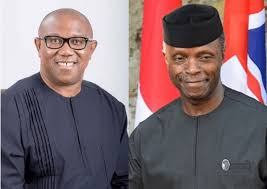
Buhari’s absence from office for some months during his medical vacation overseas and the most recent vice presidential debate, which caught public attention after the two major vice presidential candidates of the two major political parties, Prof Yemi Osinbajo of the ruling All Progressives Congress (APC) and Peter Obi of the opposition Peoples Democratic Party (PDP), brought to the fore how important the office of the vice president can be.
Although there were other candidates who took their turns in the debate to discuss the proposed policy programme of their political parties, attention was mainly on Osinbajo and Obi.
While the outcome of the debate has continued to provoke public criticisms from both sides, other Nigerians have wondered what does a vice president occupy in government going by previous experiences.
Section 148 (1 & 2) clearly spells out the duties and functions of a vice president of Nigeria. Section 145 of the 1999 Constitution (as amended) says clearly gives the vice president the power to take the place of the president in acting capacity when ‘’proceeding on vacation or that he is otherwise unable to discharge the functions of his office’’….
Apart from taking responsibility in the business of governance, the executive functions of the Nigerian vice president includes participation in all cabinet meetings and by statute, membership in the National Security Council, the National Defence Council, Federal Executive Council, and the vice president chairs National Economic Council.
Although the vice president may take an active role in establishing policy in the Executive Branch by serving on such committees and councils, the relative power of the Nigerian vice president’s office may also depend on the duties delegated by the president in accordance.
‘’A vice -president obviously is not the driver of government. VPs only do what they are allowed to do”, Atiku had once said in a letter. “As VP, I can only be judged on the responsibilities I was given,” he noted.
A vice president may not be the driver of the economy but most often, the role he plays are key to driving economic policy.
‘’If Atiku took credit for assembling what he described as the best economy team in the history of Nigeria and also go ahead to give himself credit for overseeing the privatisation of public enterprises in the country under the Obsanjo’s administration, then office of the VP is key’’, Ade Marcus, a public commentator told LEADERSHIP Sunday.
Since the return of democracy in 1999, Nigeria has had no less than four vice presidents spanning the almost 20years in the Fourth Republic, but as a growing democracy, circumstances and time have really defined how they discharge their duties within or outside the confines of the law.
At the return of democracy in May 1999, Atiku was sworn in as vice president under the administration of former President Olusegun Obasanjo who singled him out to deputise him. It could be recalled that Atiku was before this time the governor-elect of Adamawa State waiting to be sworn in.
As vice president, he presided over the National Council on Privatisation, overseeing the sale of hundreds of loss-making and poorly managed public enterprises. In 1999 he, alongside South African Deputy President Jacob Zuma, launched the South Africa Nigeria Binational Commission.
Atiku was believed to have assembled the best economic team ever in Nigeria, under the Obasanjo administration which saw the stabilisation of the country’s economy in 1999 after years of military rule.
“As VP, I assembled what is arguably the best economic team ever in Nigeria. It was made up of young, world -class professionals, who came home to work. Some of those professionals are now political leaders, governors and world leaders in their own right,” Abubakar had claimed in a letter he wrote in response to criticism from ace Nigerian comedian popularly known as I Go Dye.
“I oversaw the telecoms revolution, which is why young people like you, I Go Dye, now have flourishing careers. Under our tenure, we witnessed a large repatriation of Nigerians back to Nigeria, driven by the hope of the recovering economy.
“I went to the World Bank and met a bright lady, convinced her to come back home, and she became a star in our government. To show you we had effective leadership, the same lady could not replicate her exploits under a different government,” he had stated in the letter.
He was however made inactive by Obasanjo in their second stint in office, ostensibly arising from the latter’s bid to amend certain provisions of the constitution to take another shot at the presidency (for the third consecutive time).
“I regret that I had that disagreement with my boss. Some say I was disloyal, but I looked at the events in Zimbabwe recently, and it gives me confidence that I did the right thing fighting the attempts to elongate the presidential tenure beyond eight years.
“If I did not win that fight, do you think we would be having a discussion on young people getting into leadership today?, Atiku had asked in the letter.
Clearly, Atiku had had his ups and downs, he also enjoyed the support of his boss in their first stint during which Obasanjo was travelling all over the world to rebuild Nigeria’s battered image in the international community.
The 2007 general elections ushered in a newly elected democratic government with late President Umaru Yar’ Adua and Goodluck Jonathan elected president and vice president respectively.
The relationship between both men was said to be very cordial. Yar’Adua understood that he needed the confidence and respect of his deputy. This, according to some reports from closed voices back in the villa, the late president believed should be earned through mutual respect and understanding.
Therefore, he carried Jonathan along, ensuring that he had enough work to do. Vice President Jonathan, too, had the confidence of his boss and would hardly do anything without his boss’ consent. Although there were times when Jonathan was seen as a very laid back vice president, insiders who had first-hand information about their relationship confirmed that it could be hardly noticed who was in charge between Yar’Adua and Jonathan during FEC meetings, Sanusi Daggash, then National Planning Minster had said in a report.
Occasioned by the air of anxiety that gripped the nation over President Umaru Musa Yar’Adua’s health, Jonathan took over presiding over FEC meetings. Cabals in the Yar’ Adua’s cabinet tried to hold sway to prevent Jonathan from assuming the acting president role.
‘’Some of the ministers, who would talk at the top of their voice when Jonathan chaired the FEC meeting without being indecorous though, would not even make a whimper when Yar’Adua was chairing the meeting, the former minister had said.
Yar’Adua’s refusal to transmit power to Jonathan while traveling overseas for medical care however led to a sour situation.
Read Also:
When it was suspected that the late president had become incapacitated, the high wire politicking orchestrated by Yar’Adua’s kitchen cabinet to ensure that power remained within their cycle almost plunged the country into a political crisis.
Lagos lawyer Femi Falana had in December 14, 2010 filed a suit asking an Abuja High Court to declare Yar’Adua’s failure to transmit a written declaration to the National Assembly before proceeding on medical vacation three weeks to be violation of section 148 (2) of the Constitution of the Federal Republic of Nigeria, 1999.
Falana who had demanded that the Court compel Yar’Adua to immediately transmit a written declaration of leadership of the National Assembly to empower Vice President Goodluck Jonathan to discharge the functions of the President on acting capacity, said all the Federal Executive Council meeting held during his absence were illegal and unconstitutional.
At this time, the Save Nigeria Group (SNG) under the leadership of Tunde Bakare, fiery preacher, was in the forefront of the campaign for Jonathan to take charge.
The group, which was able to garner support from influential personalities in public space, staged rallies and a series of protests; the kitchen cabinet too will not cave in easily: their message was simple, Yar’Adua could govern the country as the powers of the president are not exercised territorially.
“Yar’Adua can exercise his powers anywhere in the world, on the plane, at the meeting of the United Nations or even on his sick bed, as long as he is not incapacitated by the sickness,” Michael Aondoakaa attorney-general had said at a press conference.
While Aondoakaa was theorising, the tenure of Idirs Kutigi as chief justice of Nigeria (CJN) was nearing its end, and Aloysius Katsina-Alu was ready to mount the saddle, but the only problem was that the man who had the constitutional authority to administer oath of office on Katsina-Alu was bedridden in faraway Saudi Arabia.
“As the Vice-President, based on our laws, I do not have any powers to swear in the chief justice of Nigeria,” Jonathan had told those who wanted him to tinker with the idea.
“Ceremonial responsibilities and ceremonial functions are sometimes more serious than the real work we do. I do not have the powers to swear in the chief justice of the federation… The tradition has been there for 51 years. It is Mr President who swears in the chief justice.
“I was worried that if we get to that Thursday and the chief justice of Nigeria is not sworn in, that means one arm of government has no leader and that would have been an invitation to chaos,” he had revealed.
“In fact, I even had to approach the former chief justice, that, ‘look, I have the powers to extend your period of stay in the office. Since I cannot swear in a new chief justice, can I extend your stay in office so that there will be no vacuum?’
“But he said it was not possible because the constitution says at the age of 70, he must go. But he promised he was going to re-examine the laws,” said Jonathan.
However, few days to the expiration of the tenure of the former CJN, the attorney-general had approached Jonathan and showed him the act that says either the president or the chief justice of the federation can swear in the new chief justice of the federation. That law was there but nobody saw it.
On December 30, 2009, Kutigi administered the oath on his successor, and trust Nigerians, this created conundrum among lawyers that Rotimi Akeredolu, former governor of Ondo state, who was then the president of the Nigerian Bar Association (NBA), had accused Kutigi of foisting two CJNs on the nation.
Akeredolu said he was worried that the task which had been traditionally reserved for presidents was usurped by the retiring CJN.
All said and done, Jonathan was made acting president and was re-elected with his vice, Namadi Sambo. During Jonathan’s era vice president Namadi Sambo was more in the back ground.
During the Jonathan era, the Minister of Finance Ngozi Okonjo-Iweala was said to have in most cases chaired the National Executive Council (NEC), because she had better knowledge of the economy than the vice president.
The former minister’s influence at the NEC on one ocasion led to a friction between her and former Osun State Governor, Rauf Aregbesola.
‘’I recalled one session early in 2014, where I was quizzed, harangued and bullied by some governors and then verbally assaulted by Governor Aregbesola of Osun State’’, the former Finance Minister made the revelation in her book: Fighting Corruption Is Dangerous, The Story Behind The Headlines.
Buhari and Osinbajo came into power with more expectations from the way things were done in the past. Like late Yar’Adua and Jonathan, the relationship between Buhari and Osinbajo has been cordial and robust.
Aside carrying out his constitutional duties, from 2015 to 2017, President Buhari had forwarded three different letters to the National Assembly to transfer power to the vice president to act as president when going on either medical or normal leave. It was the first time in the history of Nigeria, that a president voluntarily transmitted power to his deputy.
The first time was in February 2016 when the President embarked on a five-day vacation; and the second time was in June 2016 when Mr. Buhari went on a trip to the United Kingdom for medical treatment.
In May 2017, there was a peculiar development. The President had forwarded an official communication to the Senate informing the Senators of his medical leave to the United Kingdom but the wordings were faulted by the Senators as being defective. This time, it was clear that the president would not be coming anytime soon.
The crux was that the president in the letter applied the word ‘coordinating’ instead of ‘acting’ as supposed.
‘’In compliance with section 145 {1) of the 1999 constitution as amended, I wish to inform the distinguished Senate that I will be away for a scheduled medical follow up with my doctors in London. The length of my stay will be determined by the doctor’s advice.
“While I am away the vice president will coordinate the activities of the government. Please accept the distinguished senate president the assurances of my highest consideration.”
There were insinuations in some quarters that Buhari might have been advised by some cabals in cabinet deliberately draft the letter as such to limit the powers of the vice president over uncertainty about his health.
This was manifested in the seeming cold war between Osinbajo and some forces in government circle but this did not last long as the acting president continued to carry out his constitutional duty.
‘’Nigerians have witnessed such seamless functionality of the office of the vice president only in the Muhammadu Buhari presidency. The vice takes over government each time, the president transmit letter of such to the National Assembly. He has the full powers of the president, acts and signs all national documents, policies or laws as de facto president because it was what the constitution envisaged’’, said Mr Williams, who noted that there were however forces who wanted to work against it.
He said for instance, unlike what transpired during the Jonathan era, Yemi Osinbajo as acting president, sworn in Walter Onnoghen as the substantive chief justice without controversies.
One must commend President Muhammadu Buhari for empowering his deputy to act. Otherwise, history would have repeated itself, and George Santayana, the Roman philosopher, who said: “Those who do not learn from history are condemned to repeat it”, would have perhaps been laughing in derision.
Evidently, the smooth relationship between the president and his vice president is crucial to not just governance but stability within the political space. As much the bonding process between the key leaders cannot be overemphasised, the character traits and experience of the individuals involved will be crucial.