
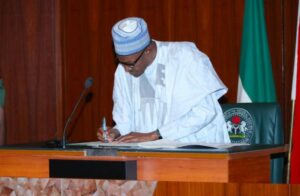
President Muhammadu Buhari has commended the African Development Bank President and its management for the Bank’s successes and also pledged Nigeria’s continuous support for the institution.
At a meeting with the Bank’s President, Akinwumi Adesina in Abuja, President Buhari recognized the support that the African Development Bank has given Nigeria in recent times. “I remember the Bank’s critical gesture in 2016 during the difficult period of economic recession through a US$600 million budget support facility. We appreciate this and assure you that we will continue to work towards a diversified Nigeria.” The meeting was attended by some of the country’s Ministers and senior government officials.
President Buhari commended the Bank’s interventions in infrastructure and agriculture, and encouraged the institution to keep supporting countries like Nigeria to grow agriculture as a business through the promotion of agro-industrial zones in the country.
African Development Bank President Akinwumi Adesina thanked President Buhari for his support to the Bank and pledged the Bank’s commitment to fast


track Africa’s development.
Adesina also highlighted several reforms at the Bank and strategic efforts to move the Bank’s operations closer to countries.
“The African Development Bank’s robust operations in Nigeria have had significant results and impacts on the ground, and continue to accelerate the country’s economic transformation as well as improve the lives of millions.”
At the end of March 2019, the Bank’s active portfolio in Nigeria comprises 60 operations with total commitments of US$4.5 billion. These include 28 public sector operations with total commitments of US$1.7 billion (21 national and 7 regional); 34 non-sovereign operations with total commitments of US$2.8 billion.
Following Nigeria’s request to the African Development Bank, Adesina reported that the United Nations Secretary-General, Antonio Guterres, has accepted to co-chair a multi-billion fund-raising session to revive the Lake Chad – a strategic effort that has major climate, economic, agricultural and employment implications for the region.