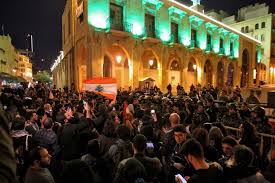



Lebanese demonstrators south slogans in the capital Beirut on December 15, 2019. – Lebanese police clashed with anti-government protesters in Beirut late Sunday, firing tear gas to prevent them from breaching barricades near parliament, (Photo by ANWAR AMRO / AFP)
Lebanon’s president on Monday postponed consultations to select a new prime minister after weeks of largely peaceful street protests descended into violence, leaving dozens wounded in clashes with security forces.The government stepped down on October 29 in the face of unprecedented nationwide demonstrations demanding the complete overhaul of a political class deemed inept and corrupt.
On Monday the presidency announced that President Michel Aoun had “responded to the wishes of (outgoing) prime minister Saad Hariri to postpone parliamentary consultations until Thursday, December 19.”
It is not the first time the talks have been delayed. Parliamentary consultations had been scheduled for December 9 before being pushed back a week.
The names of various potential candidates to replace Hariri have been circulated in recent weeks but bitterly divided political parties have failed to agree on a new premier.
Cabinet formation can drag on for months in the multi-confessional country, with Hariri taking almost nine months to reach an agreement with all political sides for the last one.
Read Also:
The head of the powerful Shiite movement Hezbollah, a key political player with ministers in the outgoing government, said on Friday that “the formation will be no easy feat”.
The name of a new prime minister is frequently picked before symbolic parliamentary consultations, but Hassan Nasrallah said that “parliamentary blocs have not agreed on a name”.
According to a complex political system that seeks to maintain a fragile balance between religious communities, Lebanon’s prime minister is always a Sunni Muslim.
Earlier this month the Sunni Muslim establishment threw its support behind Hariri returning, further angering protesters who have demanded a cabinet of independent experts.
‘Hariri will not return’
The latest delay to the consultations on a new premier came the day after clashes near the parliament building in the capital Beirut between protesters and security forces.
Rallies had begun peacefully with protesters waving Lebanese flags and chanting “Hariri will not return”, but escalated later, with demonstrators throwing water bottles and firecrackers at the security forces who responded with tear gas and water cannon.
Saturday evening had seen dozens of people hurt when security forces used tear gas and rubber bullets to disperse demonstrators who tried to breach metal barricades near the legislature.
Interior Minister Raya El-Hassan on Saturday ordered security forces to open a “rapid and transparent” enquiry into what was the most violent episode since the anti-government protests began.
The protests that were sparked by the announcement of a new tax have been largely peaceful, but clashes have increased in recent weeks.
The consultation delay comes despite the need for a government to address a deepening economic crisis.
The international community has urged a new cabinet to be formed swiftly to implement key economic reforms and unlock international aid as Lebanon’s debt-burdened economy slides towards collapse.
French Foreign Minister Jean-Yves Le Drian on Sunday urged Lebanese leaders to push to resolve the crisis paralysing the country, warning of a “dramatic situation”.
Lebanon is facing a dollar liquidity crisis that has crippled imports and seen banks limit greenback withdrawals and transfers.
With banks failing to provide sufficient dollars, the US currency has been selling for more than 2,000 Lebanese pounds on the parallel market for the first time since it was officially pegged at 1,507 in 1997.
The World Bank has projected Lebanon’s economy will shrink by 0.2 percent this year but now warns the recession could be even worse.
Around a third of Lebanese live in poverty, and that figure could soon rise to half, it says.