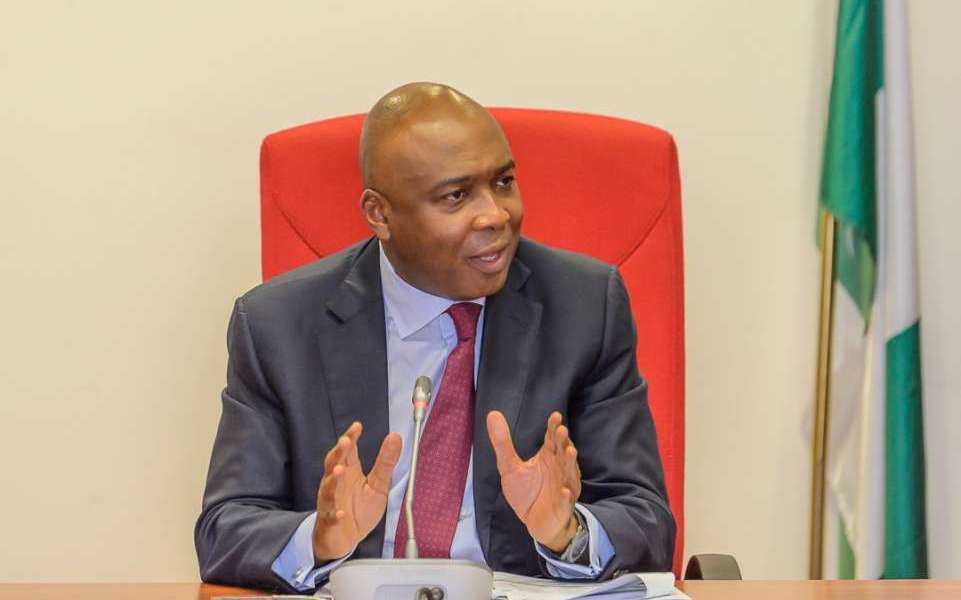

Northern senators have rejected the criteria canvassed by outgoing Senate President, Dr. Abubakar Bukola Saraki, for the emergence of his successor.
Saraki had asked the senators-elect to use merit, competence and performance to elect their leaders and not blind party loyalty.

But the chairman of the Northern Senators’ Forum, Senator Aliyu Magatakarda Wamakko (APC Sokoto) said that they would comply with the All Progressives Congress (APC) directive on the matter.
APC national chairman, Comrade Adams Oshiohmole, had penultimate Sunday when President Muhammadu Buhari hosted the party’s senators-elect to a dinner at the State House, said that the Senate leader, Senator Ahmed Lawan from Yobe State and Hon. Femi Gbajabiamila were the party’s anointed candidates for the Senate presidency and speakership of the House of Representatives, respectively.
Also yesterday, the Christian Association of Nigeria (CAN) urged the lawmakers-elect in both chambers to ensure religious balance in the sharing of their principal offices.
In 2015, against the directive of the APC, Senator Saraki formed an alliance with the opposition Peoples Democratic Party (PDP) to emerge the Senate president.
During an orientation programme for lawmakers-elect at the Transcorp Hilton, Abuja yesterday, Saraki urged them to elect leaders who can perform.
Saraki, who advised the new lawmakers not to resort to meetings outside the chambers on the day of inauguration, said that the leadership of the Red Chamber is not superior to other members.
He said: “Your first assignment would be at the National Assembly on the day of inauguration” and warned them not to attend any meeting outside the parliament on the day of inauguration.
Saraki continued: “The point I am making is that we should not make too much news on the process of electing a presiding officer. What is important is for the members of the Senate to decide who is best suited to lead them so that the Upper Chamber can have stability.”
Saraki also opened up on why the Red Chamber failed to confirm the acting chairman of the Economic and Financial Crimes Commission (INEC), Ibrahim Magu, saying that President Buhari did not lobby for him or present another person for the office.
He stated this when he responded to questions from three lawmakers-elect on why the 8th Assembly did not confirm Magu as the substantive EFCC boss.
The 8th Senate had refused to confirm Magu’s appointment, citing the Department of State Services (DSS) report which ‘indicted’ him as the reason.
Saraki told the new lawmakers that all the decisions taken at the chambers are binding on them, added that Senate leadership has no power over their colleagues.
He said: “The truth really is that the issue of confirmation whether ministerial or other appointments is done by the entire Senate. Generally, we have an unwritten practice that we would get the input of senators from the state where the appointee hails from before we start the screening process in the Senate. By the powers of the Senate if such a nominee is rejected, then it is upon the executive to find a replacement. The issue really is that the Senate has the powers to reject a ministerial nominee.
“In the case of the appointment of the chairman of the EFCC, the powers of the Senate are very clear in the constitution. For any nominee, we are guided by the constitution. It is an appointment made by Mr. President, subject to the confirmation of the Senate, which means the Senate has the powers to either say yes or no. In a situation where the Senate rejects, it is up to the executive at that time to send in a replacement or in some cases, when we have appointment rejected, the executive will re-present before the Senate but if the senators again, took a decision to reject the nominee, the appointment stands rejected,” Saraki said, apparently referring to the Magu issue.
On getting judicial interpretations of their roles, Saraki said that the Senate filed 17 cases in court which have been on for two years.
“For one reason or the other, those cases have not moved. I cannot explain what happened. They are cases that have to deal with asking the courts to give judicial interpretations to who has the powers to do one thing or the other. I am sure by the time the judiciary gives the interpretations, there is no doubt about it that it will be clear that it is the Senate that has the powers,” Saraki said.
But Wamakko, who is also the chairman of the Senate Committee on Basic and Secondary Education, said that the lawmakers were in support of the position of the APC leadership.
According to Wamakko, the northern senators believe in democracy and party supremacy hence it has no candidate but would abide by the position of the APC.
He, however, appealed to Nigerians to pray for the best, as according to him, it is service to the fatherland that should come first.
Wamakko also urged Nigerians to continue to support the lawmakers with prayers, useful counsel and constructive criticisms where necessary for the overall well-being of the country.
Read Also:
He assured President Muhammadu Buhari that they would deliver creditably well in their legislative duties.
Also, the Senate leader and contestant for the office of the chairman of the National Assembly, Senator Ahmed Lawan, who also used the opportunity to campaign for himself, said: “We are reaching out to all our colleagues regardless of their political persuasions; after all we are supposed to work together.
“It won’t be a Senate for only the APC members. It is a Senate that will consist of the APC, PDP, and YPP. Therefore, we need everybody to support the genuine and laudable course of making Nigeria better. I will ensure that our administration is able to deliver laudable projects to Nigerians and the best way to achieve this is for us to work together,” he added.
Reps Caucuses Divided Over Gbajabiamila, Others
And as the race for the speaker of the 9th House of Representatives hots up, the various caucuses in the chamber seem to have taken seemingly irreconcilable stance on the matter.
Only last Sunday, the House leader (Gbajabiamila) and chairman, House Committee on Marine Safety and Education, Hon. Umaru Mohammed Bago, joined the race for the seat.
Gbajabiamila’s entrance into the race has however caused some ripples in the Green Chamber.
While the North Central Caucus of the House has maintained its stand that the position of the speaker should be zoned to the zone, the Northeast Caucus seems divided on the issue.
The leader of the North Central Caucus, Hon. John Dyegh, in a statement he issued, said that for the purposes of equity and fair play, the office should be ceded to the zone.
Dyegh said that ceding the speakership position to the region would advance equity in the distribution of positions in the country, especially as the Northwest and Southwest had produced the president and vice president respectively.
According to him, it was not a coincidence that the 1999 Constitution (as amended) provides for federal character in the distribution of offices and leadership in the country.
“We note that apart from the North West and the North East, the North Central zone delivered handsomely for the party in the general elections, and as such needs to be rewarded for the hard work and loyalty,” he said.
On its part, the Northeast seems divided as the leader of the caucus, Hon. Mohammed Tahir Monguno and some members, including those who had indicated interest in the position, have thrown their weight behind Gbajabiamila.
In 2015, Monguno was Gbajabiamila’s deputy in the contest for the speakership position but Hon. Yakubu Dogara clinched the office.
Speaking with LEADERSHIP on the caucus’ position, Monguno said: “It’s not possible to say that all the members of the caucus are supporting Hon. Gbajabiamila but the majority of them are for him. Some of them are also contesting for the same seat; people like Hon. Betara and Namdas are interested in the position.
“But I can assure you that 90 per cent of the caucus are going with the party and supporting Gbajabiamila and the caucus will soon declare this publicly,” Monguno stated.
CAN Seeks Religious Balance
Meanwhile, leadership of the Christian Association of Nigeria (CAN) has called for balance in the appointments of the principal officers of the National Assembly across religious divides to avoid domination and marginalisation of any kind in the interest of equity, justice, and fair play as enshrined in the 1999 Constitution (as amended).
The association in a statement signed by its president, Rev. Samson Ayokunle, said that it “recognises the importance of the National Assembly to the stability and growth of the nation’s polity and in this regard called for ethnic and religious balance with depth in picking it leadership.”
Ayokunle also called for the removal of any apprehension and suspicion harboured towards the leadership of this country.
He said: ‘’Although both the Senate and the House of Representatives have several principal officers, our focus here is the Senate president, the deputy Senate president, the speaker and the deputy speaker.
“As it has been the practice since 1999, whenever the Senate president is a Christian, the speaker of the House has always been a Muslim and vice-versa. And the same thing happens to their deputies.
“Our quest becomes imperative due to the existing order in the two other arms of the government. Today, both the president and the acting Chief Justice of Nigeria are Muslims and our appeal is to let either the Senate president or the speaker be a Christian to address the religious dichotomy. This will give all Nigerians a sense of belonging irrespective of their religious affiliations,’’ he said.
CAN said that in as much as “we agree that merit should not be sacrificed in every appointment, there are Christians who are equally credible and capable of running the affairs of the National Assembly and other key positions in the government if given the opportunity.
“Those who had and still serve in one office or the other are our living proofs,’’ he added.