
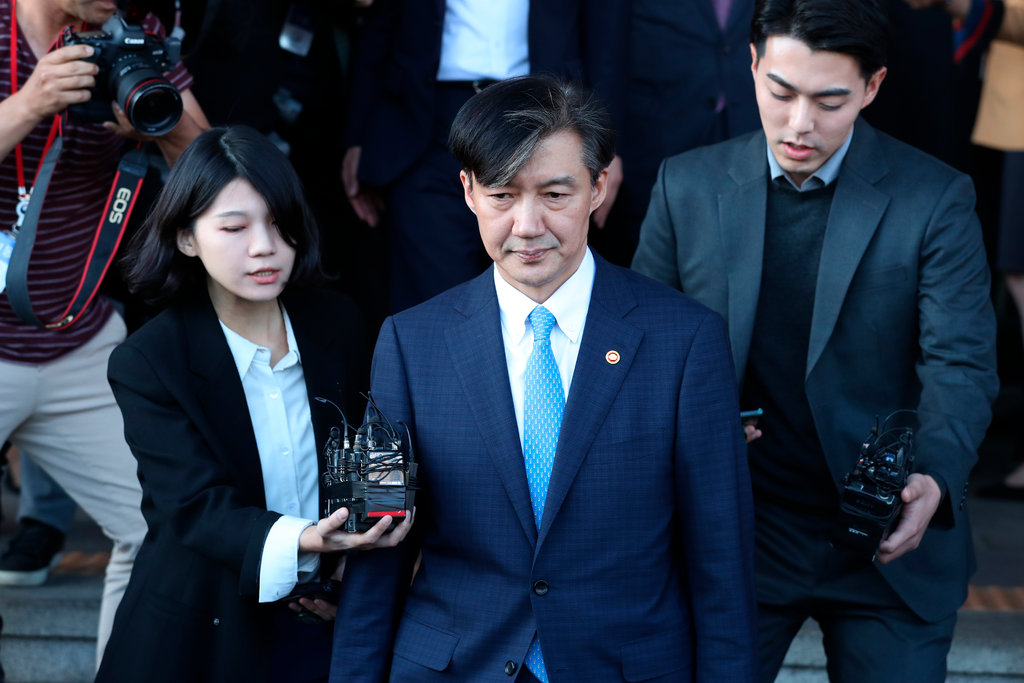

South Korea — A key ally of President Moon Jae-in of South Korea on Monday stepped down as justice minister, handing a victory to South Koreans who have been holding enormous rallies for weeks demanding his removal.
The minister, Cho Kuk, has been plagued by allegations of ethical lapses and financial wrongdoing in his family ever since Mr. Moon appointed him to the post in early August. Since then, prosecutors have opened an investigation into the accusations, and for weeks huge crowds have gathered in the capital, Seoul, to oppose Mr. Cho’s appointment.

Although Parliament refused to endorse Mr. Cho’s appointment, Mr. Moon formally made him justice minister last month, saying he needed Mr. Cho to push through his plans to overhaul the national prosecutors’ office, the same agency investigating Mr. Cho’s family.
People who supported Mr. Moon and Mr. Cho have since staged large counter-rallies, accusing prosecutors of using their investigation to topple Mr. Cho and scuttle Mr. Moon’s efforts to overhaul the prosecutors’ office. But the widening polarization has cost Mr. Moon heavily, with his approval ratings sliding in the wake of Mr. Cho’s appointment.
On Monday, Mr. Cho issued a statement explaining his decision: “I decided that I should no longer burden the president and the government with affairs concerning my family,” it read.
Mr. Cho said he had remained in his post despite a growing chorus of demands for his removal from both the news media and the political opposition because he wanted to finish the task of reforming the prosecutors’ office.
Mr. Cho resigned shortly after the Justice Ministry announced on Monday a new set of measures that included sharply reducing the size of the so-called special investigative bureau of the prosecutors’ office. The powerful, elite bureau has led politically sensitive criminal cases. Surveys have found that prosecutors in South Korea are deeply mistrusted by the public, and they are often seen as doing the political bidding of whoever is in power.
Every South Korean president — including Mr. Moon — has vowed to take politics out of the agency, only to be later accused of using it to harass political opponents or divert attention from domestic crises.
On Monday, Mr. Moon said he was sorry that his appointment of Mr. Cho had caused such divisions. But he praised Mr. Cho for pushing for the overhaul of the prosecutors’ office, which Mr. Moon said remained one of his government’s top policy goals.
Mr. Cho was a leading champion of that goal.
But since his appointment, the local news media has been filled with allegations of misdeeds by his family. His wife has been indicted on charges of forging a certificate to help their daughter get into medical school. She is also under investigation for possible criminal links to a relative who was arrested on suspicion of embezzlement.
Many of the allegations against his family remain unsubstantiated and Mr. Cho has denied any lawbreaking.
But many students and even some of the usual supporters of Mr. Moon turned against Mr. Cho after it was revealed that his daughter had benefited from advantages denied to other students — a sensitive matter in a country where anger over economic inequality runs high. College students began holding rallies against him, calling him a hypocrite.
As a university professor, Mr. Cho won national fame with his tireless call for more equality. On Monday, Mr. Cho said he was resigning because he had done what he could to reform the prosecutors’ office. But, he added, “I apologize to the young people who have been hurt by my family.”
Before Mr. Cho resigned, his ministry had deprived scores of senior prosecutors of their chauffeur-driven cars (a perk enjoyed by just a few senior figures at most ministries). It also ended the humiliating practice of forcing people to stand before a bank of news cameras before entering a prosecutor’s office for questioning.
But the centerpiece of efforts to change the prosecutors’ office — a bill that would create an agency to investigate corruption among prosecutors, as well as other senior officials — is still pending in Parliament.