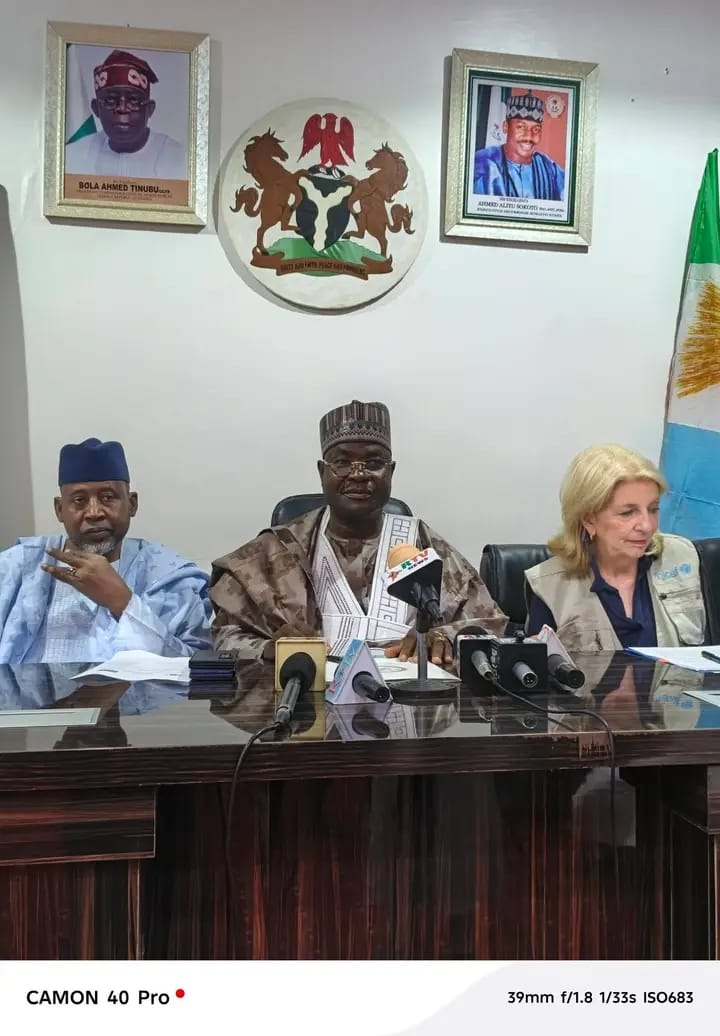

The Executive Director of the United Nations Children’s Fund, Catherine Russell, on Friday commended the Sokoto State Government for its investments in healthcare, education and skills development, describing the initiatives as critical to improving children’s welfare and strengthening human capital.
Russell, who spoke during a visit to the Government House in Sokoto, also praised the state’s commitment to ending polio and expanding routine immunisation coverage.

She said UNICEF remained optimistic that Sokoto could close its remaining immunisation gaps and emerge as a model for political commitment to child survival in Nigeria.
“I saw your government’s clear vision for health, education and skills development for children. I welcome the state’s investments in these critical areas, and UNICEF stands ready to continue supporting the government to strengthen systems, improve service delivery and generate evidence that guides smarter investments,” she said.
According to her, investments in children not only improve learning outcomes but also build human capital and drive long-term economic growth.
Russell recalled that Nigeria’s certification as free of the wild poliovirus in 2020 demonstrated that difficult public health challenges could be overcome through strong leadership, community engagement and partnerships.
She stressed the need to sustain those gains by ensuring every child receives routine immunisation, all missed children are reached and disease surveillance remains effective.
Read Also:
The UNICEF chief said she visited a digital village where literacy, vocational training and life skills programmes were being implemented, as well as a primary healthcare centre providing routine immunisation and nutrition screening.
“They are really fantastic projects, and I am grateful that UNICEF is able to work with the government to support them,” she said.
Russell expressed confidence that Sokoto had the potential to become a national model for translating political leadership into measurable improvements in children’s lives.
“Your administration has already put important policy reforms in place. UNICEF remains your trusted partner to translate this vision into results. Together, we can build on this momentum and position Sokoto as an example of how political leadership can contribute to Nigeria’s future prosperity,” she added.
Responding, Governor Ahmed Aliyu, represented by his deputy, Mohammed Idris Gobir, thanked UNICEF for selecting Sokoto as one of the states to be visited during Russell’s mission to Nigeria.
The governor expressed appreciation for UNICEF’s interventions in the state, saying his administration had prioritised maternal and child healthcare through free medical services since assuming office.
He disclosed that the state had recruited more than 1,500 nurses and midwives for deployment to rural health facilities and had also engaged 2,440 Community Health Extension Workers to strengthen primary healthcare services across the state.
Aliyu further said the government had established skills acquisition centres for Almajiri and out-of-school children, noting that 2,720 beneficiaries had completed training and received starter packs to support their livelihoods.
He, however, acknowledged that the prevailing security challenges in parts of the state continued to affect access to education and healthcare services.