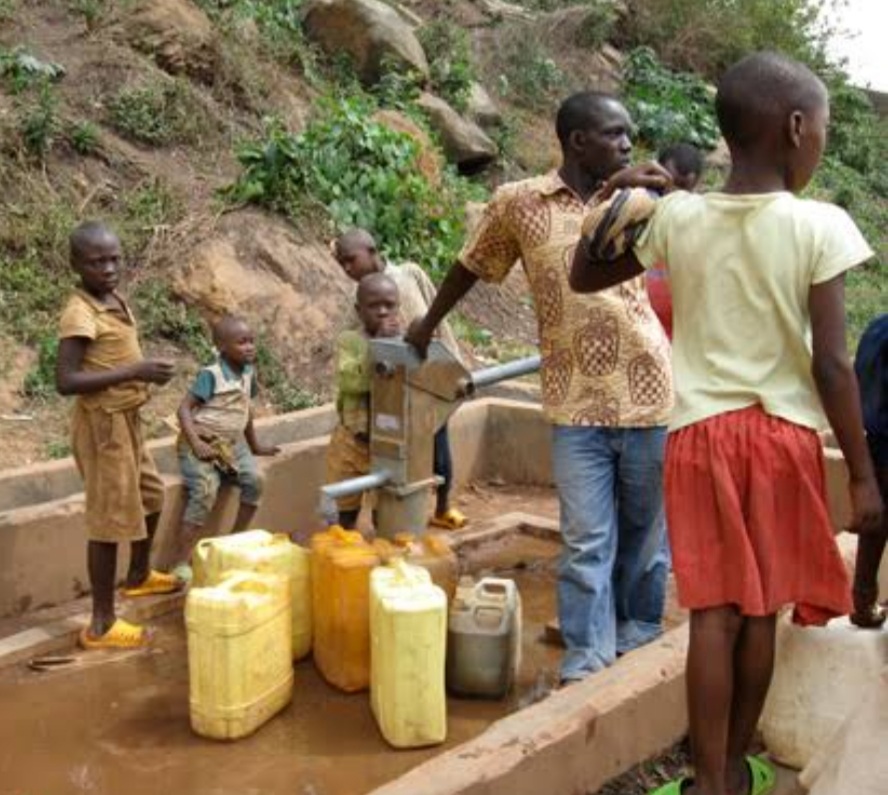

Politics aside, let us stop deceiving ourselves, Sokoto State Government can hardly satisfy the densely populated communities with the desired quantity of potable water. This is because, water scarcity has been a problem that greets successive governments of the State.
With this, households should augment with hand-dug wells as the case in various states of the North, and the South as well. The well-to-do, philanthropists, corporate bodies and organisations should also complement by sinking boreholes across communities.
It is pertinent to note that, while the water provision plans by recent governments go in arithmetic progression, the population grows in geometric progression.
It was also learnt that the old Sokoto Water Scheme initiated in the late 1950s through the ’60s, was designed to be expanded at regular time intervals to meet the population growth.
However, it was virtually not until in the 1980’s that some reasonable expansion works were done (especially during the reign of Col. Ahmed Daku rtd.) through the mid 1990s which hardly meet the continuously expanding state capital and environs.
At that time, the water expansion works penetrated the nook and cranny of Sokoto metropolis when giant water pipes were laid along major roads and small pathways of adjoining dwellings.
A number of us were witnesses to launching the completion of the Sokoto Water expansion works by the then Head of State Gen. Ibrahim Babangida.The Sokoto water scarcity lingers especially from the outset of the current political dispensation when Sokoto metropolitan areas and communities grew and continue to grow massively thereby merging with neighbouring towns and villages which all rely on the only main water system to feed them.
Since then, no state governor evades criticisms from either water shortage or scarcity. At the outset of the current political dispensation in 1999, Attahiru Bafarawa’s government, first, addressed the problem of lack of water treatment chemicals which was adversely affecting water supply at the time.
We can recall as reporters at the time that, Sokoto State Water Board and Sokoto Main Water Intake on Kware road, were Bafarawa’s first place of call on assumption of office as Governor. That was when his government did some expansion, servicing and refurbishing works at the main Sokoto water intake and at the main Water treatment plant. Towards the end of Bafarawa’s second tenure of office, boreholes were also sunk at various places to augment the water problem.
Aliyu Wamakko’s era as Sokoto State Governor which started in 2007, also faced and struggled with the problem. Wamakko’s era witnessed massive provision of boreholes and moderate-water stations with giant water storages in the nook and cranny of not only Sokoto metropolis, but the various towns and villages.
This is apart from the repairs and replacement of the giant water pipes from the Sokoto Main Water Intake. Aminu Waziri Tambuwal’s government which started in 2015, also took some measures in handling the water problem though the efforts can’t match those of Bafarawa and Wamakko.
The measure of excessive sinking of boreholes across communities appears to be a good one. Satisfying the entire Sokoto State capital and environs with adequate water supply can however be achieved but not immediately. It is said to be a long-term plan. With increasing technological advancement, the project is possible especially if other competing problems such as insecurity are absent or diminishing; we pray for such.
In the current situation however, an average Nigerian in Sokoto State ought to continue to include the water problem among the life challenges similar to the power supply, food, education, personal security, health and the like. Going by the current situation also, it is necessary that government workers especially those from areas hit by the problem, should be excepted from paying water levies if at all they pay, to enable them have a little sigh of relief.
A stitch in time saves nine.