
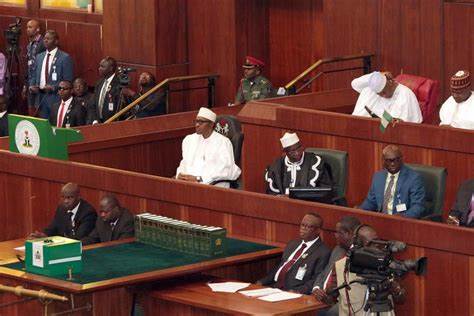

The general elections in Nigeria are for the purpose of electing the President, Vice-President, the Senate members and House of Representatives members.
The last general elections produced the required 109 senators from states across the country while the Federal Capital Territory elected one senator.

Similarly, 360 members of House of Representatives were elected in single-member constituencies.
These are positions clinched through the votes of the electorate that consider the votes as a mandate for such elected public officers to serve in that capacity.
But in some occasions, it is not uncommon to discover that after a politician has been confirmed elected, he is selected to function in another capacity other than the position he has got by the mandate of his constituency.
For instance, one of the inaugurated members of the House of Representatives, Emeka Nwajiuba, is among the 43 ministers appointed by President Muhammadu Buhari.
Nwajiuba, a native of Ehime-Mbano Local Government Area of Imo, is representing Okigwe South Federal Constituency.
He was elected on the platform of the Accord Party during the election but Buhari nominated him to represent Imo as a minister.
He has been in the House of Representatives from 1999 to 2003 who had resigned his membership of the House of Representatives before taking up the ministerial appointment to allow for another candidate from his constituency via a bye-election.
Apart from Nwajiuba, Sen. Tayo Alasodura (Ondo Central), former Sen. Adeleke Mamora and former Sen. Gbemi Saraki (Kwara), are good examples of the switch from elective posts to get ministerial appointments.
Political pundits, therefore, wonder whether or not it is right to wave aside the mandate and get the new offer to function in another capacity.
Further to this, concerned citizens argue that there ought to be something attractive to the politicians that will make them to abandon elective positions for executive positions.
Former Oyo State Gov. Abiola Ajimobi, believes that ministerial appointments should go to younger members of the party in Oyo State.
He says that although President Muhammadu Buhari has not offered him ministerial appointment, he would prefer to be in the Senate for personal reasons.
Although analysts note that elected offices easily become entangled with money, most of them agree that many politicians might prefer elected offices to secure the attention of their followers.
However, an analysts, Mr Dokun Abraham, observes that being in National Assembly as a lawmaker is more useful except in the event where such a lawmaker is appointed to a “cardinal ministry.
“Unlike a ministerial position which is an appointment that can be terminated at any moment, the National Assembly is for a fixed term.’’
He also notes that a position in the National Assembly as a lawmaker creates better opportunity to impact on the lives of the constituents.
Read Also:
Sharing similar sentiments, a member of the House of Representatives, Dr Ajibola Muraina (PDP-Oyo), says that the electorate benefit the most when an elected member of the legislature is considered fit for another position even though he won the mandate of his or her constituency.
According to him, there is nothing wrong for a member of the National Assembly, State Assembly or Local Government Council, leaving the legislature to join the executive arm of government.
“What is important is the experience and that in most cases; they perform better because of the legislative experience over the years.
In the areas of budgeting, legislation and oversights, their experience will come to bear in governance and you can be sure their policies will be robust, doing much better than those who have not pass true the legislature,’’ he observes.
Identifying Mr Rotimi Amachi as a good example of such switch, he notes that Amechi has been in the parliament for many years and when he became governor of Rivers, he well.
“So, in the event that an elected politician is selected to form the executive unit of government, it is better for the electorate and the credit goes to the electorate who identified and voted the person.
“The appointment is only coming to confirm the ability of the appointee and to give him new areas where he can perform better,’’ he says.
Similarly, the spokesman of the House of Representatives, Rep. Benjamin Kalu (APC-Aba), says that it is about the competence and the capacity the person has built over time either in the executive or at the legislature.
According to Kalu, if someone is in the legislature and understand the mindset of the arm of government, he will understand the mistakes being made by the executive.
“And if you are in the executive and you find out you can do better for the legislature, it is right to move.
“It boils down to experience, capacity and efficiency to drive through the office; you can acquire through expectancy through studies.
“The problem we have is that we have misfits, people who are not qualified to run a particular office not because he has the capacity to deliver the expected outcome.
“There is a thin line between the three arms of government even in the face of the principle of separation of powers which insist they work independently but there is a place where they collapse the wall.
“In all, there are three arms, there is only one government; none can work in isolation of the other.
“The earlier we remove the friction between them and allow the collapse to be smoother; we will definitely have a better government,’’ he notes.
An analysts, Mr Martins Odeh, observes that when an elected politician makes a switch to get another appointment, the electorate transfer the mandate to another candidate within the constituency through bye-elections conducted by the Independent National Electoral Commission.
“In that way, the bye-election knocks off the former mandate and renew it in the next prefer candidate, so it is in order,’’ he says.
He explains that bye-elections make provision for any vacant positions to be filled in the event of incumbent’s death or resignation or when the incumbent becomes ineligible to continue in office because of a recall and criminal conviction, among other reasons. (NAN)