
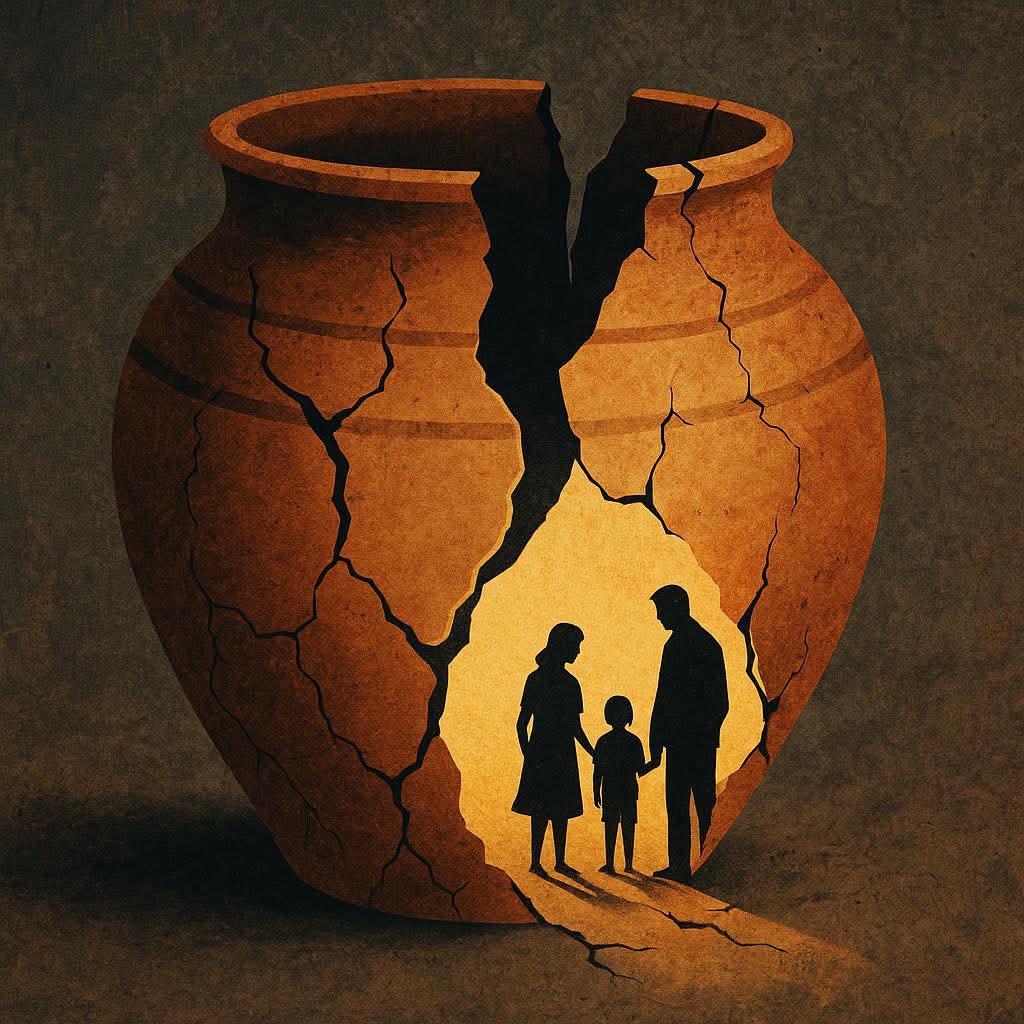

. .When fathers vanish and mothers are left alone, the collapse of family becomes the collapse of society.
I spend a lot of time with young people. Many of them come under my care—artists, creatives, budding academics, members of book clubs, and even aspiring politicians. I make time to listen: to their aspirations, their ambitions, and their worries.

Many of them are brilliant—intelligent, energetic, and hungry to find meaning in their lives. They ask questions about the future, about leadership, about how to make sense of the chaos around them.
But when the conversation turns to family, the mood often shifts. Too often, the answers are painful: “My father is long gone, I don’t know where he is.” Sometimes, though less often, they say the same of their mothers. More frequently, it is that the father has died—leaving a void that nothing seems to fill.
For many of these young people, the word parent is not a source of guidance or comfort but a reminder of absence.
This is more than private sorrow. It is the symptom of a deeper social breakdown.
The Crumbling Bedrock
The family has always been the first school of values. It is where love is learned, discipline is shaped, and belonging is nurtured. When that foundation is weak or absent, society itself begins to wobble.
I often ask myself: who or what would I have become without both of my parents in my formative years? Their different temperaments, talents, values, and qualities contributed immensely to who I am today. Because of this, I look with pity at young people who never had the chance to draw from the love and wisdom of both parents.
Across our communities, the signs are everywhere:
• Young men restless and adrift, searching for role models in the wrong places.
• Youth drawn into drugs, gangs, and destructive cults in search of belonging.
• A rising culture of detachment where responsibility is easily abandoned.
When fathers vanish and mothers are left to carry the load alone—when children grow up without a sense of home—we should not be surprised when society becomes harsh, fragmented, and unstable.
Read Also:
Take a closer look at those drawn into Yahoo—the fraud economy glamorized as success. Many of them were pushed there by the absence of fathers, while mothers, desperate to prove themselves in the father’s absence, encouraged their children to “succeed” by any means. Scamming became not just survival, but a misguided badge of victory. Have you heard of the Association of Yahoo Mothers? What could be more egregious?
What This Portends
If left unchecked, this trend will only deepen. A generation raised without the safety net of family becomes vulnerable to anger, alienation, and exploitation. They are easy prey for crime lords, populists, extremists, and opportunists who promise belonging but deliver destruction.
The erosion of the family is not just a private tragedy—it is a public danger. It threatens the cohesion of our communities, the stability of our politics, and the very soul of our nation.
We are already seeing the consequences. Many of those raised by the streets now find themselves in high offices. For them, legacy and values mean little. The theft of public resources is self-validation. They chase unearned glory and hollow titles, all in a bid to declare, “Here we are after all.” Their bitterness and unresolved anger are being unleashed on society. They take more than they need—not out of necessity, but to fill a void created long ago by want and deprivation.
What Can Be Done
This is not a problem government alone can fix, though policies on education, jobs, and social support are essential. Nor can it be left to families already stretched thin by economic and cultural pressures.
Communities must step in. Mentorship must fill the gaps where fathers and mothers have failed. We must revive our cultural values of shared responsibility, where an uncle, a neighbor, or a teacher can act as a guiding hand. We must return to the age of the community—the village—as paterfamilias.
Above all, we must remember this truth: presence is power. To be there for a child—whether our own or another’s—is to offer a compass in a confusing world.
A Call to Reflection
What kind of society are we building if more young people know loneliness than love? What future awaits if home is no longer a place of belonging, but of absence?
The family is not perfect, but it remains the most enduring unit of social stability. When it collapses, the cost is borne by all.
We cannot afford to look away.