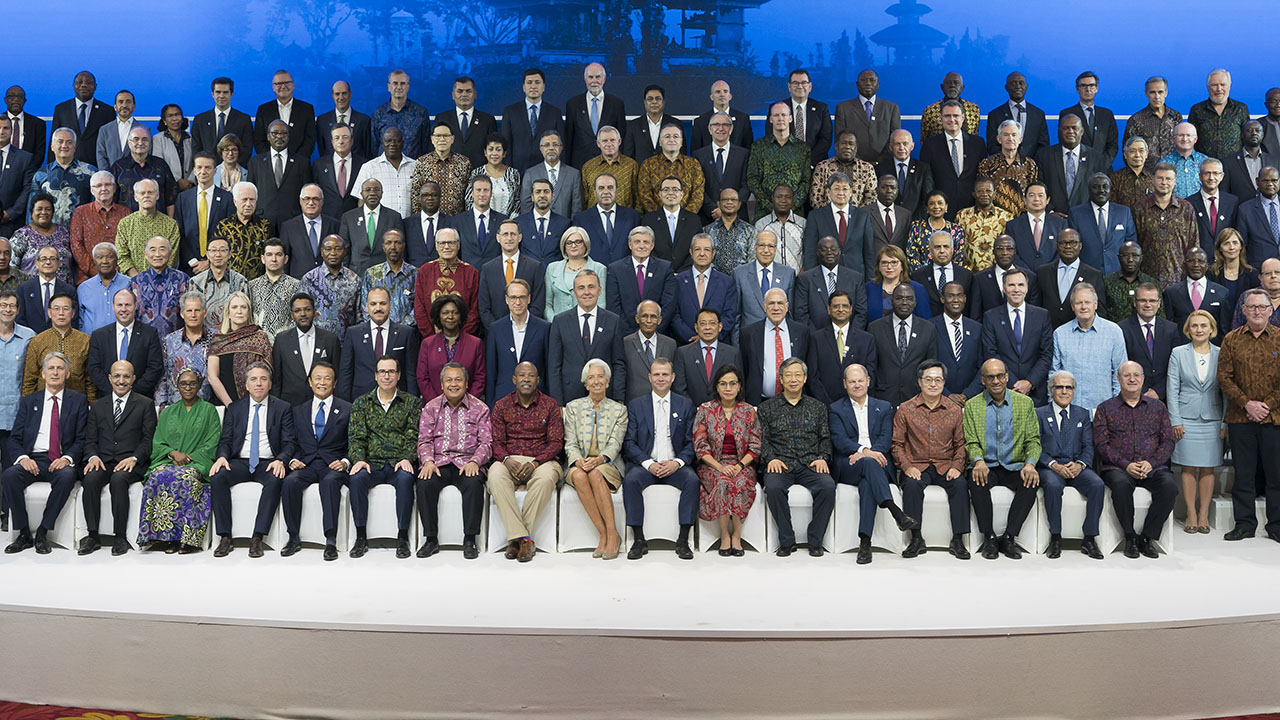


International Monetary Fund Managing Director Christine Lagarde (C-front) poses with finance ministers and Central Bank governors during a group photo at the International Monetary Fund (IMF) and World Bank annual meeting in Nusa Dua, on Indonesia's resort island of Bali on October 13, 2018. (Photo by Stephen Jaffe / International Monetary Fund / AFP)

As the Federal Government steps up plans to offer more of its assets for sale under the ongoing privatisation programme, stakeholders in Nigeria’s capital have renewed the call to ensure that the exercise is done through the capital market.
The stakeholders argued that the exercise would witness high level of transparency and success, if government tapped into the resources available within the capital market space.
Furthermore, they maintained that it would have a multiplier effect on the economy, because government will get a fair value; and the buyers have access to funds to run the companies, while investors reap good returns on their investments.
The Governor, Central Bank of Nigeria (CBN), Godwin Emefiele, while briefing Nigerian delegation at the end of the International Monetary Fund/World Bank Group meetings in Bali, Indonesia, affirmed that the Federal Government is ready to offer more of its assets for sale soon.
Read Also:
He said the ongoing privatisation programme aimed at raising more money to implement the country’s 2018 deficit-based budget.
Already, the exercise have kicked off with the recent offloading of the Nigerian Security Printing and Minting Company Limited Plc, with the CBN, which already had majority stake, emerging the preferred buyer, given the company’s security status.
“I am aware, as a member of the National Council on Privatisation that more (assets) are coming, and I believe in due course that the Bureau of Public Enterprise (BPE), will make these available for us. I am aware of the situation of the Ajaokuta Steel Company of Nigeria. It is also on the cart, first for a total review of the process of privatisation and payment, so that our aluminium sector can eventually come alive,” he said.
But market operators and investors have insisted that the capital market remains the most transparent and efficient channel to divest from these assets.
Specifically, the Managing Director, Highcap Securities Limited, Imafidon Adonri, in a chat with The Guardian said there is a need to privatise all public enterprises in Nigeria, because many government officials are corrupt and cannot manage any commercial enterprise profitably.
He added that the privatisation exercise will be more transparent and successful with huge impact on the economy if done through the capital market.
Similarly, the President, Association of Stockbroking Houses of Nigeria, Patrick Ezeagu, submitted that if the sale of federal government equity in the state-owned companies is done through the capital market, it would benefit both the government and the investing public, while also deepening the capital market.
The President, Progressive Shareholders Association, Boniface Okezie, said: “Aside from making sure that the exercise is done through the market, government need to do a lot of explanation to Nigerians on who is buying the privatised assets. We want to know whether they are selling it to themselves or to the foreigners.
“The essence of creating the BPE is to privatise, sell the assets to Nigerians, and get them listed on the Exchange for people to become co-owners of these companies built with taxpayers’ money, but the reverse is the case presently, it is quite unfortunate,” he said.
The President, Constance Shareholders Association, Shehu Mallam Mikail, said: “If our government is really serious with privatisation, they must ensure that the exercise is done through our stock exchange for the benefit of the citizens. It would also encourage Nigerians to participate actively in the market, and boost our market capitalisation,”
Source: G Business