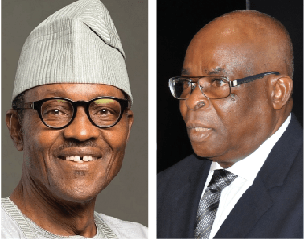

In this report, AHURAKA YUSUF ISAH writes on how the current trial of the suspended CJN Onnoghen is drifting the National Judicial Council into murky waters of the nation’s politics.
When the news broke out in the wee hours of Monday January 28 that the National Judicial Council (NJC) would hold an emergency meeting over the suspension of the Chief Justice of Nigeria (CJN), Justice Walter Onnoghen, several people thought it was to fall back on precedence it earlier set by suspending Judges standing trial in Courts.

NJC had on November 3, 2016, suspended seven judges facing trial for allegations of corruption, including bribery and perversion of justice.
The Judges are: Inyang Okoro (Supreme Court), Sylvester Ngwuta (Supreme Court), Adeniyi Ademola (Federal High Court, Abuja), Kabir Auta (Kano High Court), Mu’azu Pindiga (Gombe High Court), Mohammed Tsamiya (Court of Appeal, Ilorin), and Justice I. A. Umezulike (Chief Judge of Enugu State).
The Department of State Services (DSS) had raided homes of the seven judges on October 7 and 8 on allegations of corruption, including bribery and perversion of justice.
In a statement signed by Soji Eyo (Esq) at the end of its 79th Council meeting led by Justice E. O. Ayoola, a retired Supreme Court Justice, and the head of the transparency and anti-corruption policy implementation committee stated that the move was to ensure transparency and eliminate corruption in the judiciary.
The statement reads: “Council has decided that judicial officers shall not be standing trial for alleged corruption and be performing judicial functions at the same time.
“Council, however, decided that it would ensure that judicial officers who are been investigated for alleged high-profile criminal offences do not perform judicial functions until their cases are concluded.
“Section 6 of the National Judicial Council policy aims at putting in place multifaceted strategies and guidelines that would ensure transparency and eliminate corruption in the judiciary.”
Behold, this was not it. On January 11, 2019, the Code of Conduct Bureau (CCB) filed a six-count charge against the CJN before the Code of Conduct Tribunal (CCT) over alleged failure to declare his asset upon assumption of office as provided in Section 15 (1) of the Code of Conduct Bureau and Tribunal Act C15, punishable under Section 23 (2) (a) (b) and (c) of the same Act.
Barely two weeks after, precisely on January 25, President Muhammadu Buhari relied on exparte order of the CCT and suspended Justice Onnoghen from office and also swore-in Justice Ibrahim Tanko Muhammad as acting Chief Justice of Nigeria.
Instead for the NJC to equally suspend Justice Onnoghen in line with the precedence set by the council for suspending the seven judges including two justices of the Supreme Court, pending determination of their cases, it simply chose to do otherwise.
The council allowed itself to be burgeoned into murky waters of nation politicsby giving Justice Onnoghen and Justice Tanko Muhammad, seven days to respond to different petitions written against them.
The NJC said it considered four petitions including one against the Chairman of the CCT, Danladi Umar, which was referred to the Federal Judicial Service Commission (FJSC) as the appropriate constitutional body empowered to deal with it.
According to the statement signed by the council’s spokesperson, Soji Oye, on January 29, 2019, ‘’the National Judicial Council held an Emergency Meeting today and considered four (4) petitions filed at its Secretariat. The petitions are:
‘’Petition against Hon. Mr. Justice W.S.N. Onnoghen, GCON by Zikhrillahi Ibrahim of Resource Centre for Human Rights & Civil Education;
‘’Petition against Hon. Mr. Justice Ibrahim Tanko Muhammad, CFR by Centre for Justice and Peace Initiative;
‘’Petition against Hon. Mr. Justice Ibrahim Tanko Muhammad, CFR by Olisa Agbakoba, SAN, OON; and
‘’Petition against Hon. Danladi Yakubu Umar, Chairman, Code of Conduct Tribunal by Centre for Justice and Peace Initiative.
‘’Council referred the petition against Hon. Danladi Yakubu Umar to the Federal Judicial Service Commission (FJSC) which is the appropriate constitutional body empowered to deal with it.
‘’In line with its procedure, Council also forwarded the petitions against Hon. Justices W.S.N. Onnoghen, GCON and I. T. Muhammad, CFR to them for their responses.
‘’In view of the gravity of the matters involved, Council abridged the usual response period from fourteen (14) to seven (7) working days for the Hon. Justices to respond.
‘’Hon. Mr. Justice W. S. N. Onnoghen, GCON and Hon. Mr. Justice I.T. Muhammad, CFR recused themselves from the meeting. Consequently, Council elected Hon. Mr. Justice Umaru Abdullahi, CON, former President of the Court of Appeal as Interim Chairman to preside over the meeting. Council will reconvene on the 11th February 2019’’, Oye stated.
No one can be left in doubt as to the motive of the council members who are either ostensibly dancing to the tunes of certain quarters or demonstrating solidarity with Justice Onnoghen that recruited most of them in order to have a balanced ethnic casualty.
This is just as some people have vowed that Justice Onnoghen won’t go down alone. But if this is the case, why the system can’t be challenged to send all other justices of the apex court packing with Justice Onnoghen in order to have a well-balanced ethnic, religious and regional balanced casualty.
Let us take cursory glance once more on the following; on Friday January 25, 2019, President Buhari suspended Justice Onnoghen as the CJN over his ongoing trial at the CCT. According to Buhari, he relied on the order made by the CCT which ordered that Onnoghen be suspended and swear-in next most senior justice of the Supreme Court, which is Justice I.T. Muhammad.
The order partly read: “It is hereby ordered as follows: That the defendant/respondent shall step aside as the Chief Justice of Nigeria and Chairman National Judicial Council over allegation of Contravening the provisions of the code of Conducts and Tribunal Act CAP C15 Laws of the Federation 2004 pending the determination of the Motion on notice dated 10th January 2019.
Read Also:
“That the President of the Federal Republic of Nigeria shall take all necessary measure to swear in the most senior Justice of the Supreme Court of Nigeria as Acting Chief Justice of Nigeria and Chairman National Judicial Council in order to prevent a vacuum in the judicial arm of government pending the determination of the motion on notice. “This matter is hereby adjourned to the 28 Day of January 2019 for Hearing. Issued at Abuja under the Hand and Seal of the Honorable Chairman and Member of this Honourable Tribunal this 23th Day of January 2019 By Hon Danladi Y. Umar, Hon. Chairman, and Mrs. Julie A. Anabor Hon Member II.”
The question then can be asked, would it have been practically possible for Justice Tanko Muhammad to refuse his swearing-in as acting CJN by President Buhari citing NJC Rules as reason? Which takes precedent before the other: NJC rule or the court order? Of course the court order which derives its authority directly from Section 6 of the 1999 Constitution (as amended) comes first.
Section 6 vested the judicial powers in the courts to, which include all inherent powers and sanctions of a court of law, to all matters between persons, or between government or authority and to any persons in Nigeria, and to all actions and proceedings relating thereto, for the determination of any question as to the civil rights and obligations of that person.
By and large, Judiciary has remained as “solid as the Rock of Gibraltar” irrespective of the government in control, whether it’s civilian, interim or military, like the motto of the Royal Gibraltar Regiment and Gibraltar itself, the vow is Nulli Expugnabilis Hosti (Latin for “No Enemy Shall Expel Us”).
The late Justice Ikechi Francis Ogbuagu (JSC) of blessed memory said in the case of Oba Aladegbami v. Oba Fasanmade (1988) 3 NWLR (Pt.81) 131; (1988)6SCNJ. 103; “It is now firmly settled that a court Order, must be obeyed even if such Order, is perverse, until such a time that the Order is set aside by a competent court.
In Kolawole v. A.-G., Oyo State (2006) 3 NWLR (Pt.966)50, the court held that;‘’And the judgments of the Election Tribunal and Election Appeal Tribunal remain valid and subsisting and the whole world including the appellant is bound to obey the decisions unless and until same are declared a nullity by a court of competent jurisdiction, per TABAI JCA (as he then was).
Besides, in Oba Amos Babatunde & Ors. v. Mr. Simon Olatunji & Anor (2000) 2 NWLR (Pt. 646) 557 at 572, the Supreme Court per Achike, JSC forcefully restated the principle when he held, ‘’To, therefore, disobey an order of the court on the fancied belief that the said order is null for any reason whatsoever – even if it subsequently turns out that the order in fact is proved to be null-is a risky and unadvisable decision because, until the said order is finally determined to be null and void by the court, the order subsists in the string attaching to it unmitigated. Therefore, sheer commonsense as well as prudence demands that every order of the court should be accorded due respect and no attempt made to flout the order on the flimsy reason that it is null and void.”
Ahead of his trial at the CCT fixed for February 4, Justice Onnoghen explained how he got the foreign currencies he deposited in his domiciliary accounts.
In a ‘Cautionary Statement Form’ filed at the Department of Intelligence Investigation and Monitoring, Code of Conduct Bureau (CCB), in Abuja, he said the deposits in his dollar account were from trading in foreign exchange (forex), AGRICODE, while other investment returns were from proceeds of his investments. Justice Onnoghen’s averments were contained in a voluntary statement he made at CCB.
On January 14, 2019, the AGF Abubakar Malami (SAN) directed the Nigerian Financial Intelligence Unit (NFIU) to freeze the accounts of Justice Onnoghen subject to ‘Investigation and Prosecution Pursuant to Presidential Executive Order No 6 of 5th July, 2018 on the Preservation of Assets Connected with Corruption’. The order is to forthwith restrict normal banking operations on certain accounts belonging to the CJN pending final determination of the case against him at the CCT.
These are evident enough, that Justice Onnoghen is facing trial at the CCT for alleged false declaration of his assets before the CCB.
It would be recalled that the NJC held its 87th meeting on October 3 and October 4 last year under the chairmanship of Onnoghen. At the end of the meeting, it scheduled the 88th meeting to hold on Tuesday January 15, 2019.
However, the meeting was postponed indefinitely by Justice Onnoghen perhaps to avoid a decision by the council to suspend him like the action taken on seven judges who were earlier standing trial for corruption.
For NJC to now collect and serve some petitions on Justice Onnoghen for alleged asset declaration infractions, and concurrently doing same to Justice Muhammad for stepping forward to be sworn-in as acting CJN; ostensibly to remove the two jurists in order to appease a segment of the society is a discharge of injustice of the highest point. It is a recipe for chaos in the system, and nobody shall be CJN any longer without deluge of petitions filed at the NJC against him if the petition against Justice Muhammad is entertained.
Of course, it is as good as equating procedural error, if at all there’s one, with criminal sentence (if and when proved). Verdict of the NJC on the two distinct petitions can’t be the same.
It is also abjectly wrong to say that the NJC took similar step on March 4, 2018 when it recommended the compulsory retirement of the suspended Chief Judge of Abia State, Justice Theresa Uzokwe as well as recommending the compulsory retirement of Justice Obisike Orji, who it held was illegally appointed by Governor Okezie Ikpeazu of Abia State to take over as Acting Chief Judge of the state after Justice Uzokwe was suspended from office for engaging in judicial misconduct.
That is a distinct matter from Justice Muhammad’s stepping out for swearing in on the order of the court, a refusal of which would have placed him at risk of contempt of court. I doubt if anyone would have expected a Supreme Court Justice to disobey a court order. For every rule there’s exception. Besides, that NJC rules would ordinarily have been applicable if there was no compelling court order, and if disobeying it would not lead to leadership vacuum in the judiciary.
At best, NJC should apply its standing rule of placing judges standing trial for corruption on suspension on Justice Onnoghen if it cannot take bold steps to do the needful. Justice Muhammad should remain acting CJN pending determination of Justice Onnoghen case at the CCT or so.