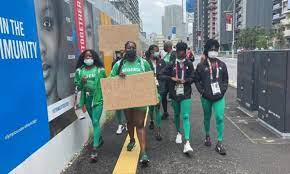

Contrary to reports that a group of 10 Nigerian athletes were banned from Tokyo Olympics, the Athletics Integrity Unit (AIU) has clarified that the athletes and 10 others from six countries were ineligible to compete at the Tokyo 2020 Games following their failure to test rigorously enough in the run-up to Tokyo 2020.
Category A National Federations are deemed by the AIU to be the most susceptible to doping so must meet certain extra requirements to be able to select an athlete for the Olympic Games or World Championships.

In this instance the rejected athletes have all been excluded from the games on the basis of Rule 15 of the National Federation Anti-Doping Obligations.
Introduced in 2019, the regulations state that in the 10 months before the Olympics, any athlete from a Category A country needs to face at least three no-notice, out-of-competition doping tests, which must be conducted at least three weeks apart.
The 20 athletes deemed ineligible for Tokyo 2020 were allegedly not subjected to these testing standards.
The AIU insists progress has been made by the Category A territories on the whole, saying in excess of 1,600 out-of-competition tests being conducted domestically – and on top of AIU tests on athletes in the International Registered Testing Pool – in the seven countries since the start of 2021. Increased testing resulted in six adverse findings, per the AIU.
“National Federations must play their part in supporting anti-doping efforts,” said David Howman, chairman of the AIU Board.
Read Also:
“The eligibility rules for athletes from ‘Category A’ countries are very clear and compliance is essential for cementing the required long-term changes and ensuring a level playing field for clean athletes.
“I must underline that there have been significant improvements in anti-doping efforts in most ‘Category A’ countries thanks to this rule.
“It is clear that the relevant National Federations in conjunction with their NADOs (National Anti-Doping Organisations) have started to take their testing responsibilities seriously, and I thank them for their efforts, but there remains a long way to go in some circumstances.”
In a chat with Nigeria’s minister of youth and sports development, Sunday Dare in Tokyo, said the affected Nigerian athletes completed their three out-of-competition-tests but the last tests were done a week before the games.
He said Team Nigeria’s athletes would have been cleared to compete due to the fact they completed the mandatory three tests if not that other nationals were also caught in the offence.
“We protested and showed the evidence that our athletes completed the three tests, and AIU would have cleared them to compete because nothing was found in their test results. But they sense that clearing Nigeria will amount to compromise since six other countries were involved,” Dare explained.